A landmark quantitative study of 4,344 Vietnamese consumers by NielsenIQ on the AWING platform reveals how connectivity in public indoor locations creates new opportunities for brands to connect physical presence with digital engagement.
O2O (Online-to-Offline) refers to strategies that connect digital interactions with real-world experiences, helping brands engage consumers across both online and offline touchpoints.
Today, as consumer journeys blur the line between physical and digital, the journey itself becomes harder to read through either lens alone. O2O is emerging as a bridge between the two, making context increasingly important to how brands understand and engage consumers. For marketers, understanding these connected moments is becoming increasingly important to creating more relevant brand experiences, both today and moving forward.
To explore how consumers behave in connected physical locations, NielsenIQ conducted a quantitative study of 4,344 consumers in March 2025 across six major Vietnamese cities (Hanoi, Ho Chi Minh City, Hai Phong, Da Nang, Can Tho and Nha Trang) through online self-surveys via the AWING platform. The research explores three areas: consumer profiles, Wi-Fi usage habits, and advertising effectiveness across public indoor locations.
The findings reveal three key areas:
- Who are these connected consumers?
- What are they doing when they connect to Wi-Fi at public locations?
- How do Wi-Fi users actually respond to advertising during the connection journey?
→ To explore the full dataset, detailed insights into location-based advertising, and how brands can leverage these signals in their strategies, please refer to the Understanding Behavior and the Impact Level of Location-Based Marketing 2025 – Full Report.
Meet the High-Value, Trend-Responsive Consumer
AWING Wi-Fi users represent a predominantly working-age, economically active, and trend-responsive audience, with strong preferences for quality and convenience.
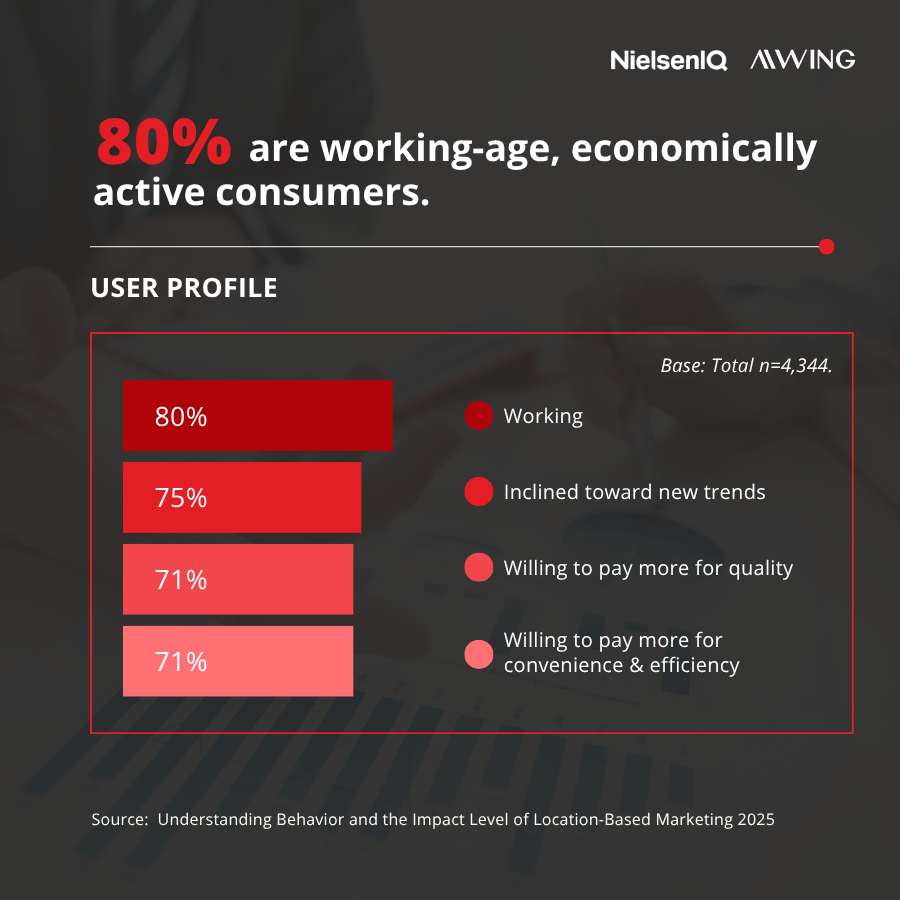
For brands today, these Wi-Fi users are more than visitors to a physical venue. They are potential consumers with spending needs, digital behaviors and openness to new experiences, making them a valuable audience for contextually relevant engagement. Understanding audiences increasingly goes beyond who they are to include the environments, moments and needs that shape their behavior.
Wi-Fi Becomes an O2O Location-Based Touchpoint
81% of AWING users regularly connect to Merchant Wi-Fi in public locations. Connectivity is often tied to purposeful moments, with 59% connecting for work-related activities such as meetings or communicating online.
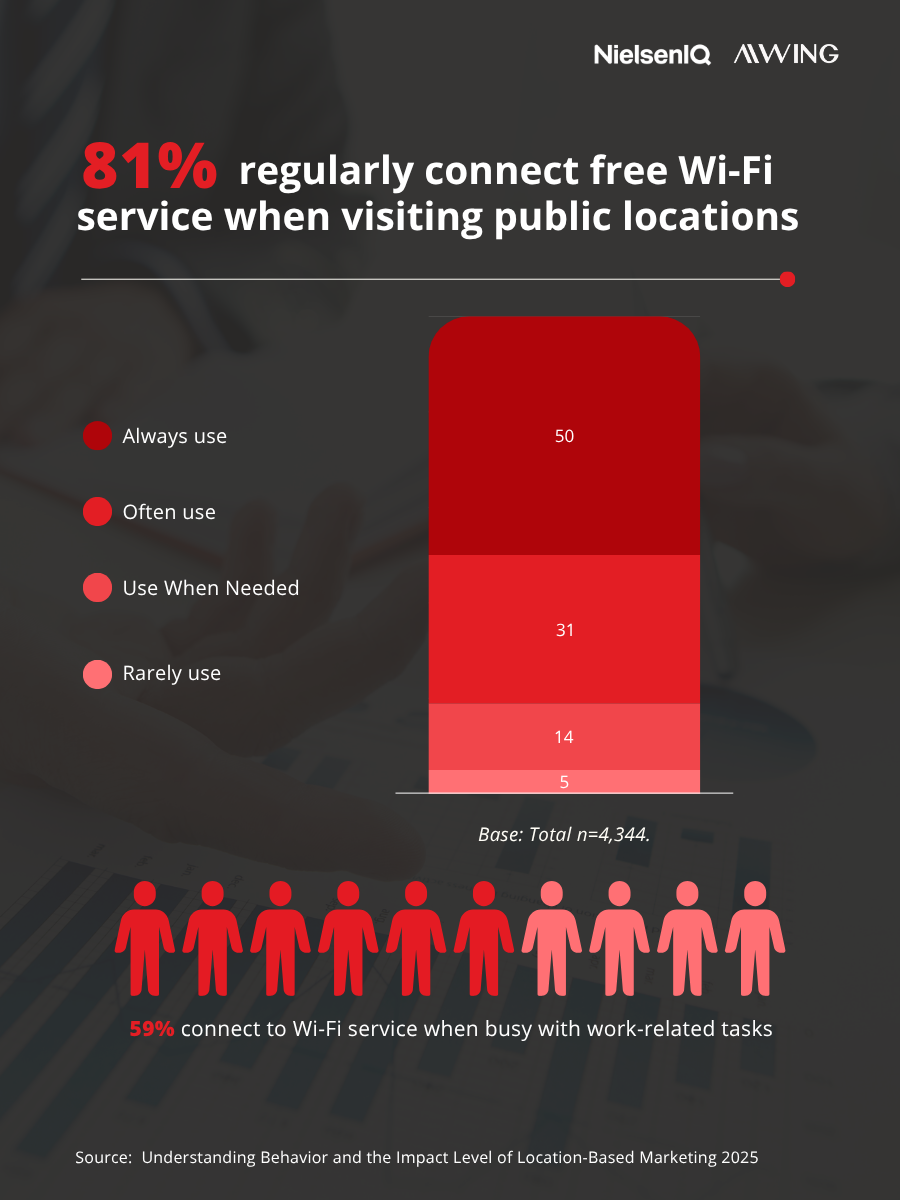
The internet connection moment therefore becomes a bridge between digital touchpoints within a physical context, where consumers are already engaged with their surroundings.
As the line between offline and online continues to blur, these moments represent the kind of connected touchpoints that can shape the next generation of O2O experiences.
For marketers, Location-Based Advertising is not only about where consumers are, but also what they are doing in that location. Location can therefore become a starting point for contextual relevance, rather than an endpoint for audience targeting.
From Connection to Attention and Value Exchange
Advertising is already part of the Wi-Fi connection journey.
86% of users (base: Total n=4,344) have encountered advertising while connecting to Wi-Fi. Among those exposed (base: Ad-exposed n=3,752), 54% actively engage with ad content, while 57% view advertising positively or accept it as part of the free Wi-Fi experience.
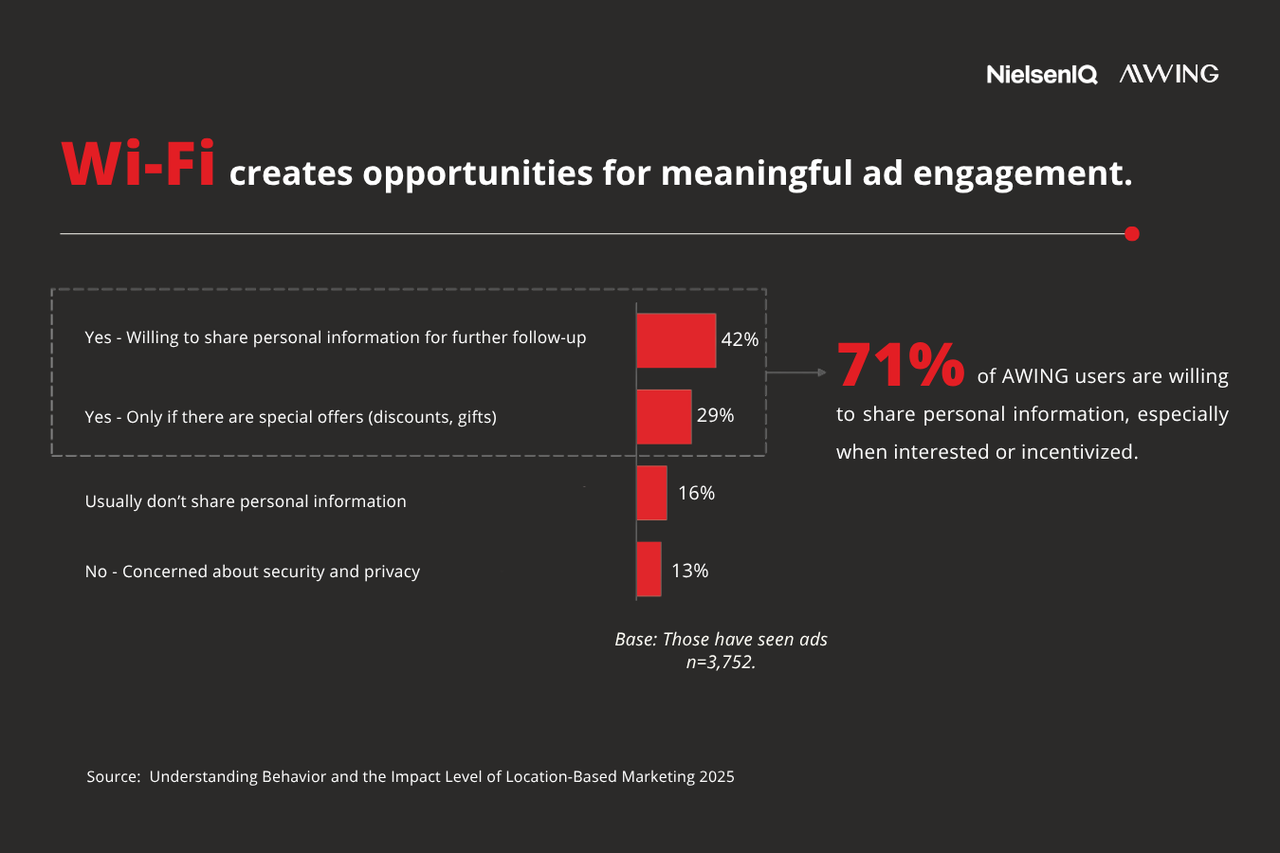
Beyond attention, 71% of ad-exposed users (n=3,752) are willing to share personal information under certain conditions. Of these, 42% would share it for further follow-up, while 29% would do so in exchange for special offers or incentives.
This points to an important opportunity for marketers: when the ad experience is relevant and the value exchange is clear, a connectivity moment can move beyond exposure to engagement and further consumer interaction.
The Location is the Context
The findings point to a simple shift in how marketers can approach Location-Based Advertising:
Consumers are defined not only by where they are, but by what they are doing and how receptive they are at that moment.
For brands, this creates an opportunity to connect physical environments with digital experiences, making consumer touchpoints more relevant, contextual and actionable.
This is where Location-Based Advertising can evolve next: from knowing where consumers are to understanding the context of the moment.
A Few Practical Takeaways for Brand and Media Teams
- Make Wi-Fi login a media touchpoint. Use the connection moment to deliver contextually relevant creative instead of generic banners.
- Target the moment, not just the location. Go beyond where consumers are and consider what they are doing and how they are engaging when deciding on messaging, creative and offers.
- Make the value exchange clear. If asking consumers to share information, give them a visible reason to opt in, such as a relevant benefit, offer or follow-up value.
- Connect physical context with digital action. Use location and behavioral signals together to create more relevant O2O experiences, rather than treating offline and online touchpoints separately.
To dive deeper into the full findings across consumer profiles, Wi-Fi behaviors and advertising effectiveness, read the full report by Nielsen IQ & AWING.