
The MMA x Decision Lab benchmark finds the skills gap outranks budget, data, and regulation as the top barrier to scaling AI, and that most teams are alert to the risks with no structure to manage them.
Marketing leaders across Southeast Asia have stopped arguing about whether to use AI. The State of AI in Marketing 2026: Southeast Asia, from the Marketing + Media Alliance (MMA) and Decision Lab, shows 57% of marketers already at an advanced adoption stage and 80% building AI into their marketing plans at a moderate level or higher.
So adoption is settled. What is not settled is why, after two years of near-universal uptake, only 17% of organisations have reached the top Expansion stage. Something is holding teams at the threshold between using AI and running on it, and the report gives a blunt answer: the constraint is human, not financial.
Skills beat budget as the number one barrier
Ask marketers what is stopping them from scaling agentic AI and the ranking is not close.
| Barrier to scaling | Share citing it |
| Talent and skills gap | 37% |
| Data quality | 17% |
| ROI uncertainty | 17% |
| Budget | 12% |
| Regulation | 10% |
| Infrastructure | 7% |
The skills gap is more than twice the size of the next barrier and three times the size of budget. The same signal repeats elsewhere in the data, with 78% of advanced adopters naming “requires skill and training” as their top AI challenge.
That reframes the investment conversation. Most marketing teams do not have a tooling problem. They have a proficiency problem, and no amount of additional licences will solve it. This is the point Rohit Dadwal, CEO and BOD of MMA APAC and Global Head of SMARTIES, makes directly in the report’s foreword:
AI transformation will not be won by procurement alone. It will be won by organisations that build AI fluency into the muscle of their teams.
The word doing the work there is muscle. Fluency is not a policy you announce or a platform you buy. It is built by repetition, and it decays without it.
Leaders build capability by doing, not by reading
The report is unusually specific about how the leading teams close that gap, and the pattern is consistent: advanced adopters over-index on active learning while early adopters lean on passive material.
| How teams build AI capability | Advanced adopters | Early adopters |
| Training courses | 68% | 44% |
| Peer discussions | 68% | 48% |
| Workshops | 66% | 52% |
| Industry reports | lower priority | 61% |
The spread on training courses and peer discussions is roughly twenty points. The spread on workshops is fourteen. And the one channel early adopters lead on is the most passive one available.
Reading about AI produces awareness. Practising with it produces capability. The teams pulling ahead are the ones putting people in rooms with real work, real tools, and peers solving the same problems. Peer discussion scoring as high as formal training is worth noting on its own, because it says the fastest route to proficiency is often another marketer who solved the problem last quarter, not a curriculum.
For any leader planning a 2026 capability budget, that is the practical instruction: fund hands-on formats first, and treat reports as the input to a working session rather than the session itself.
Senior leaders see the gap. Their teams do not.
There is a second, quieter finding that should concern anyone running a marketing organisation, because perceived readiness depends heavily on where you sit.
- On whether training infrastructure is adequate: only 45% of senior leaders say yes, against 60% of managers and juniors.
- On risk strategy: 28% of senior leaders think it is handled, against 42% of juniors.
Junior marketers are consistently more optimistic than the people accountable for outcomes, and the gap is wider on risk than on training.
The explanation is not that juniors are wrong to feel confident. Day to day, the tools work. The output arrives, the deadline is met, and nothing visibly breaks. What juniors cannot see from that vantage point is the standard the work will eventually be held to, or the consequence when an AI-assisted decision reaches a client, a regulator, or a P&L.
The operational read-through: capability gaps are least visible to the people closest to the daily work, so any readiness assessment built bottom-up will overstate how prepared the organisation actually is. If your team self-reports as ready, that is a data point about confidence, not competence.
Risk awareness is high. Governance is not.
Capability solves half the problem. The other half arrives the moment AI touches more decisions, and here the report exposes the widest gap of all.
Marketers know what can go wrong. The top concerns are data privacy (62%), biased responses (54%), fabricated answers (51%), ethical risk (50%), and cybersecurity (50%).
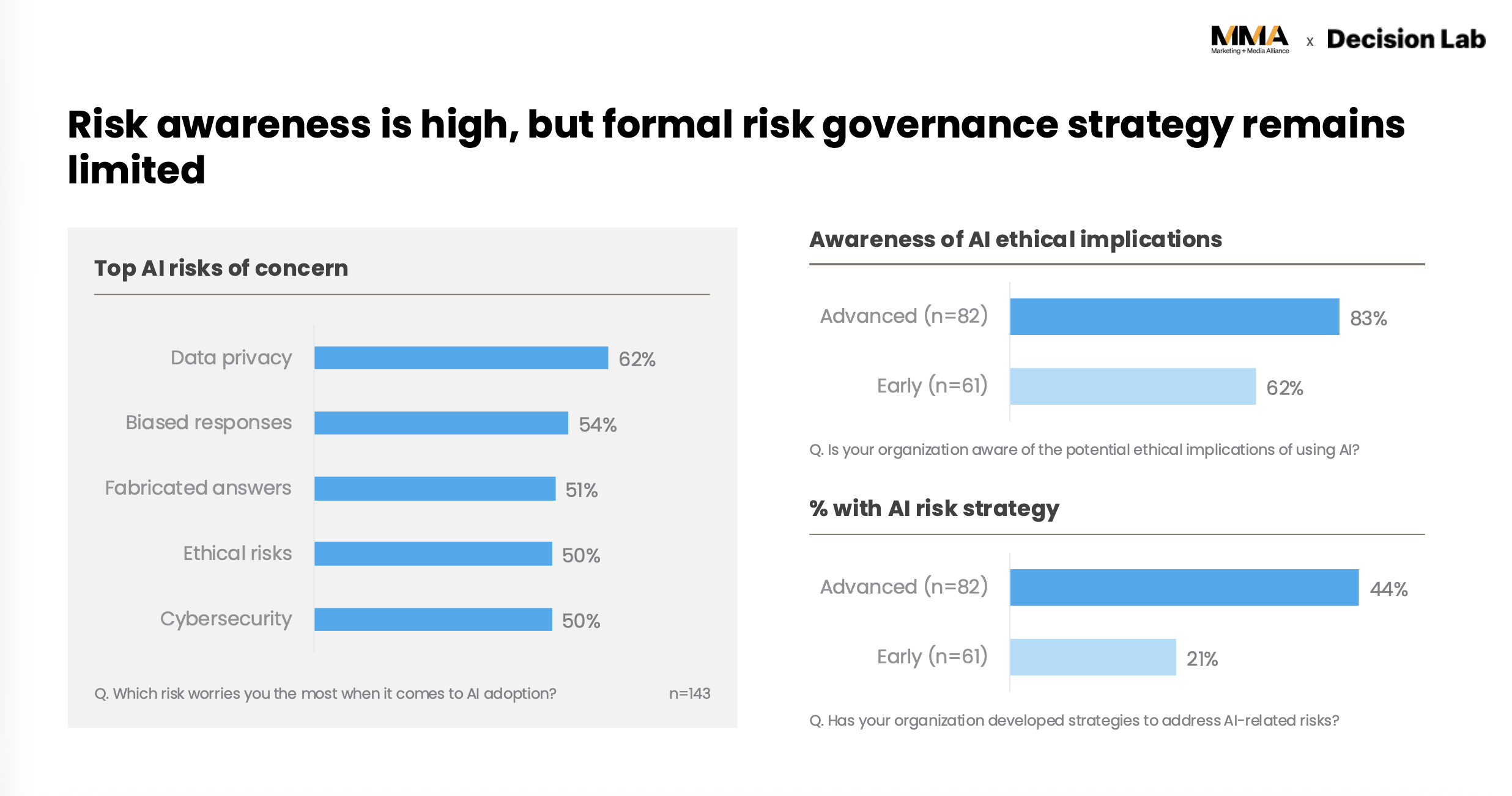
Yet only 44% of advanced adopters, and just 21% of early adopters, have a formal AI risk strategy in place.
Read that in sequence. The overwhelming majority of organisations at the advanced end recognise the ethical implications of AI. Fewer than half have written down what they will do about it. Among early adopters, four in five have nothing formal at all.
Awareness without governance is not protection. It is exposure with a paper trail, because the organisation has documented that it understood the risk and did nothing structural about it.
Rohit’s foreword puts the sequencing problem plainly:
Trust cannot be added after scale. It must be designed into the operating architecture from the start.
The timing argument matters more than the compliance one. A risk framework written for three AI use cases is a short document that a team can absorb. The same framework written after AI has spread across content, media allocation, journey orchestration, and measurement becomes a retrofit across systems already in production, negotiated with teams who now have working habits to defend. The cost of governance rises with the square of the delay.
And the stakes rise with scope. When AI drafts a caption, a fabricated answer is an embarrassing output caught in review. When AI informs media allocation or attribution, the same fabricated answer is a budget decision made on a false input, and nobody reviews it because it arrived as a number.
Enhancement, not replacement, raises the bar on skills
One more finding ties the capability and governance threads together: 83% of senior leaders say AI will enhance capability rather than replace human creativity, against 63% of juniors.
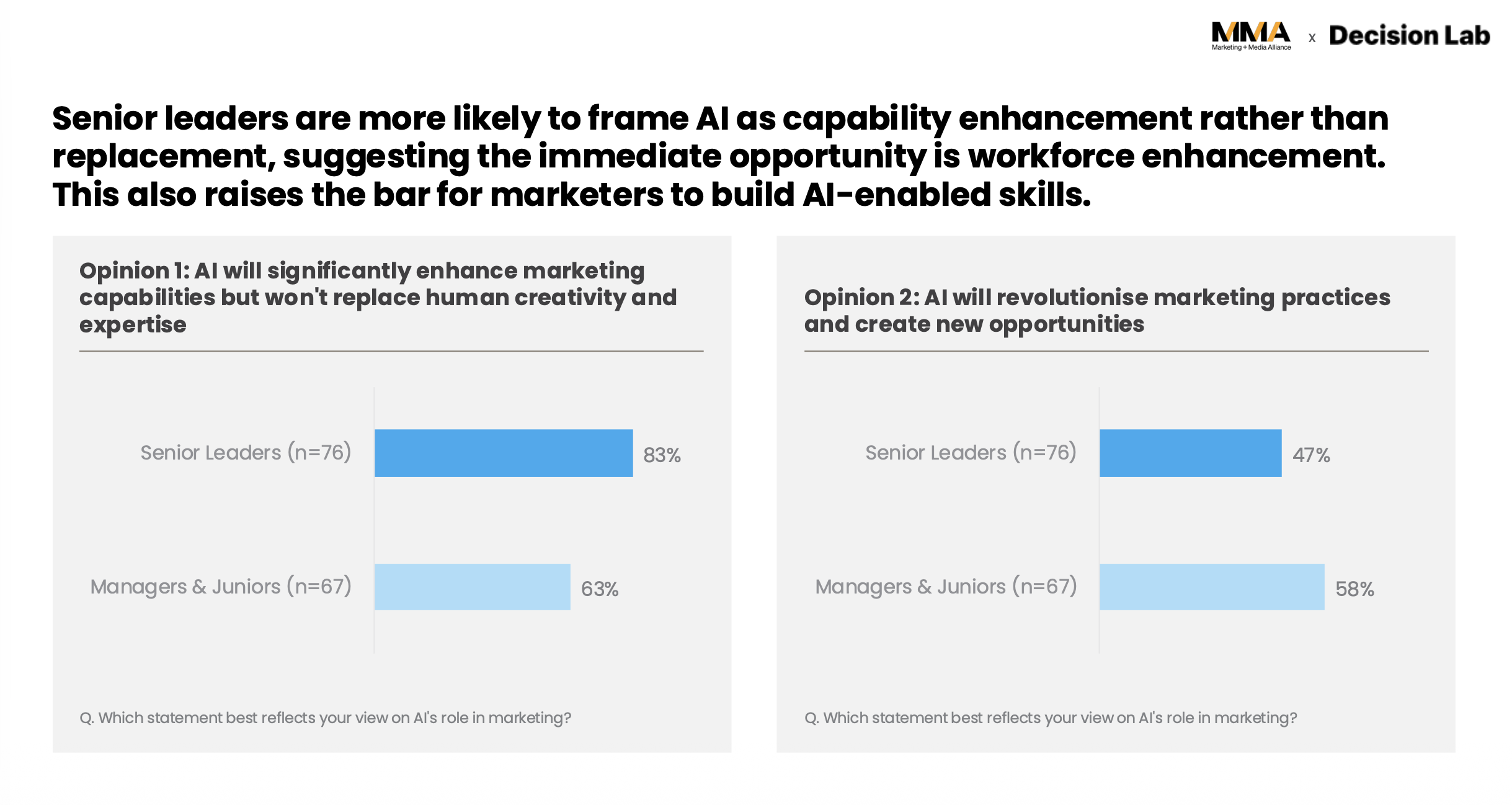
That twenty-point gap is easy to misread as leaders being reassuring. The stronger reading is that leaders understand what enhancement actually demands.
If the operating model is human plus AI rather than AI instead of human, the value of the marketer goes up, not down. But it goes up only for marketers who can direct the tools, interrogate the output, and recognise when the answer is confidently wrong. The report’s own closing implication for marketers is to keep your judgement sharp, knowing when to trust AI output and when not to.
That is a skill. It is trainable. And it is exactly the skill that passive learning does not build, because you cannot develop judgement about output you have never had to defend.
Three things to do this quarter
The report closes with implications for marketers. They translate into concrete moves.
- Move budget from tools to training. The barrier data says the marginal licence is worth less than the marginal workshop. If your AI line item is 90% software and 10% capability, the ratio is inverted against what the leaders do.
- Replace passive learning with applied learning. Courses, peer sessions, and hands-on workshops are what the leading teams run. Industry reports are what the followers read. Set the test accordingly: if a session ends without anyone having produced or corrected real work, it was information transfer, not capability building.
- Write the risk strategy before you scale, not after. If your organisation recognises AI risk but has nothing formal in place, you are in the majority, and that is exactly the problem. Start with the decisions AI already touches, name who reviews what, and define what happens when the output is wrong.
The through-line across all three is the report’s central frame: the move from AI adoption to AI readiness. Adoption tells you a team has started. Readiness tells you whether it can scale AI across functions, build the skills to run it, and govern it well enough to trust the output. Southeast Asia has finished the first part. The leaders of 2026 will be decided on the second.
Explore the full picture
The full benchmark breaks down adoption maturity, use cases, challenges, risks, and the 2026 outlook across five Southeast Asian markets, giving marketing leaders a clear read on where their own teams stand.
Download the full report:
State of AI in Marketing 2026: Southeast Asia
The State of AI in Marketing 2026: Southeast Asia is a thought leadership report from the Marketing + Media Alliance (MMA) and Decision Lab, based on a survey of 143 marketing professionals across Indonesia, Vietnam, the Philippines, Thailand, and Singapore, fielded January to April 2026.