Most conversations about AI today revolve around productivity, efficiency and speed of execution.
We use AI to draft content, build presentations, generate campaign ideas, summarize research, refine copy and automate repetitive tasks. These are valuable applications. But most are downstream applications — actions taken after the strategy has been defined, the problem framed and the key decisions made.
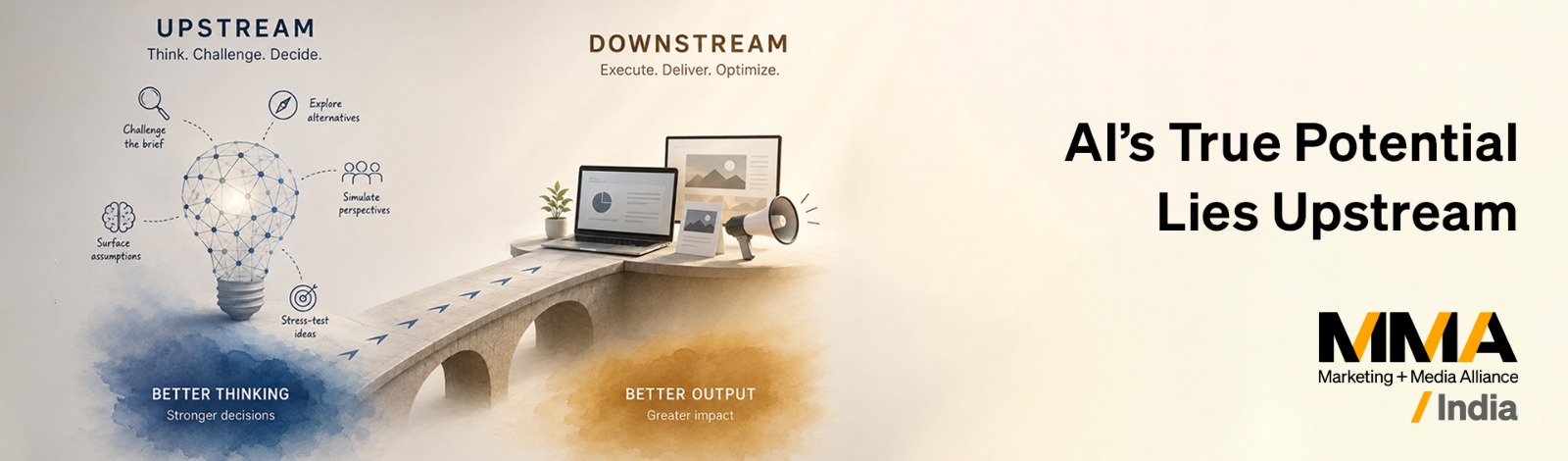
I believe AI’s greater potential lies upstream: in helping us think broader, analyse deeper and make better decisions in the first place.
AI can challenge a brief, surface assumptions, explore alternative strategic directions, pressure-test an idea, conduct a pre-mortem or simulate how different stakeholders might respond. It can bring perspectives into the conversation that may not otherwise have been considered. Most importantly, it can expand the range of possibilities we explore before we commit to a course of action.
That changes the role of AI fundamentally.
Consider a typical marketing decision. A team may begin with an accepted business objective, develop a brief, identify a target audience, arrive at a proposition and then use AI to generate creative routes. AI can certainly make the final stages faster. But what if it entered the process much earlier?
What if it challenged whether the brief was framing the problem correctly? What if it identified an audience the team had overlooked? What if it presented competing interpretations of the consumer insight? What if it stress-tested the proposition against different cultural, behavioural or stakeholder perspectives?
The final output would still be created and judged by humans. But the thinking that precedes it would be broader and more rigorous. And the quality of that thinking inevitably influences the quality of the outcome.
This is where I believe marketing leaders need to rethink the role of AI.
The competitive advantage will not necessarily belong to organizations that generate the most content or produce campaigns the fastest. It will increasingly belong to organizations that use AI to improve the quality of the choices behind that content and those campaigns.
This also requires a shift in how we think about human expertise.
The rise of AI does not make experience, intuition or judgment less important. In many ways, it makes them more important. AI can surface possibilities and perspectives at extraordinary speed, but humans still need to determine which questions matter, which trade-offs are acceptable, which context is relevant and ultimately which path to pursue.
The opportunity, therefore, is not to put AI in charge of decisions. It is to give decision-makers a more powerful thinking partner.
And this principle extends well beyond marketing. Strategy, product development, customer experience, talent, communications and even capital allocation involve decisions where the quality of thinking can matter more than the speed of execution.
The question leaders should therefore be asking is not simply: “Where can AI help us do this faster?”
It is: “Where should AI enter the conversation before we decide what to do?”
That is where I believe AI’s true potential lies.