If marketing is to play a more influential role in enterprise leadership, it must first confront an uncomfortable truth: influence without credibility is temporary.
Across conversations and debates, there was broad agreement that marketing needs a larger seat at the table. As consumer behaviour fragments, AI reshapes discovery, and growth becomes harder to engineer, businesses increasingly need marketing’s perspective in strategic decision-making. But the conversation cannot stop there.
The real question is whether marketing has done enough to earn that influence.
For decades, marketing has been one of the most powerful drivers of business growth, yet one of the least codified disciplines within the enterprise. It has built iconic brands, shaped consumer behaviour, and created entire categories. Yet compared to finance, operations, or supply chain management, marketing has often relied on inconsistent methodologies, fragmented measurement systems, and subjective interpretation.
That is becoming increasingly difficult to defend.
In boardrooms governed by financial discipline, operational precision, and measurable outcomes, credibility is earned through evidence. Marketing cannot continue to ask for strategic authority while operating without the level of rigour expected from every other enterprise function.
This is precisely where MMA’s work becomes important. The industry’s challenge is not a lack of creativity. It is a lack of standardisation.
Through four dedicated think tanks—MATT, MOSTT, ALTT and DATT—MMA is systematically addressing the structural weaknesses that have historically limited marketing’s influence.
While MATT focuses on attribution and measurement, MOSTT delves into organisational design and capability building. ALTT deals with AI leadership and responsible adoption and DATT helps unlock the commercial value of data and customer experience. Together, they represent a coordinated effort to build the frameworks, operating models and accountability systems that turn marketing from a function into a management discipline.
The findings are sobering.
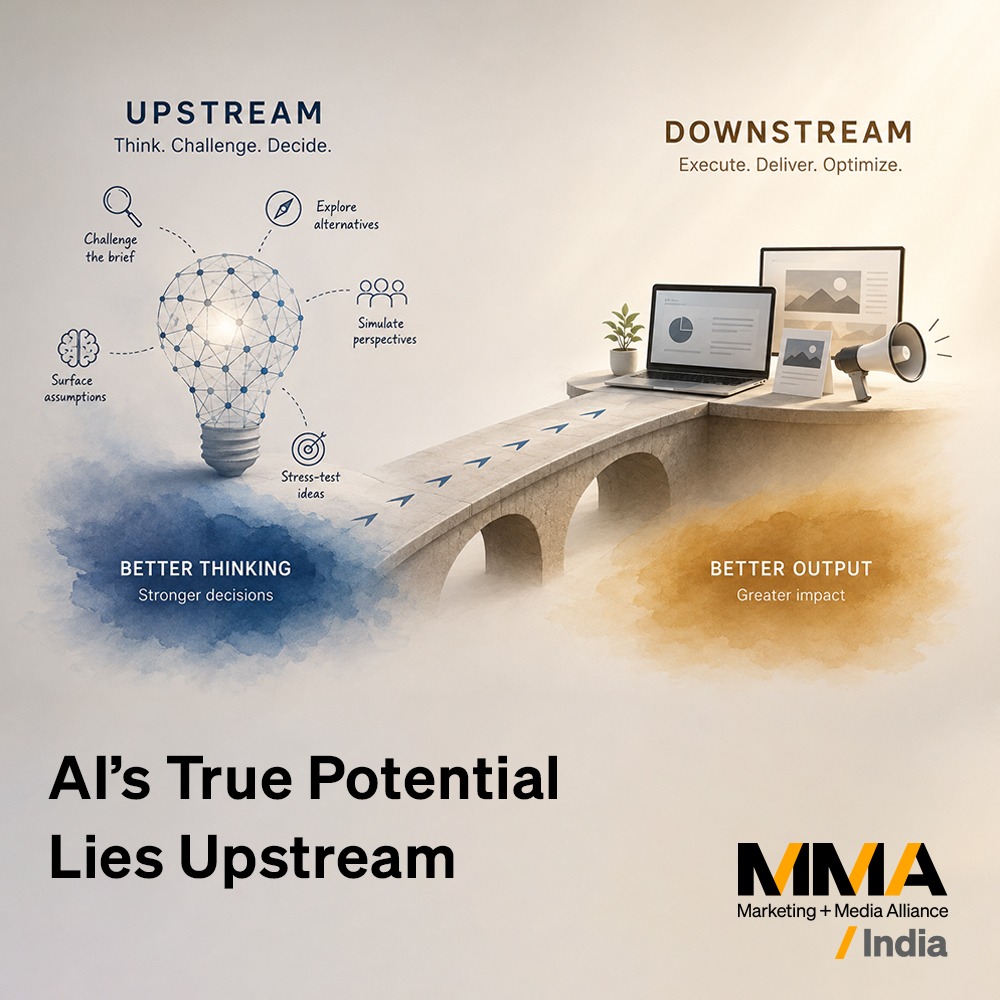
Research shared through MMA’s attribution initiatives suggests that nearly half of marketing campaigns fail before a single media dollar is deployed—not because of poor execution, but because the underlying strategic choices are flawed. The implication is that scale alone cannot compensate for weak strategy. In fact, AI may amplify the problem by accelerating the deployment of ineffective decisions.
At the same time, the opportunity has never been greater.
According to the AI Marketing Maturity Study 2026, between 84% and 88% of marketers deploying AI across measurement, propensity modelling, and customer journeys report medium-to-high business impact.
The study also found that 50% of organisations are investing in in-house measurement and insights capabilities to create a real-time source of truth for decision-making. These are unmistakable signs of a profession becoming more accountable.[Text Wrapping Break]
However, what matters is whether marketers can build systems that consistently convert insight into value.
This requires a new operating model built on five foundations:
- Standardised growth frameworks
- Measurement as a strategic capability
- AI-enabled intelligence systems
- Organisational accountability
- Continuous capability development
The future will not belong to the marketers with the largest budgets, the most content, or the newest tools. It will belong to those who can demonstrate a repeatable link between marketing activity and business outcomes.
That is ultimately how CMOs will earn greater influence. Not by asking for a larger voice in the boardroom, but by bringing stronger evidence into it.
Key Takeaway
The future of marketing will be determined by its ability to combine creativity with scientific rigour. In an AI-powered world, the biggest risk is scaling flawed assumptions faster. The marketers building evidence-based systems, capable of consistently translating consumer understanding into measurable business value, will win.