Every generation of business leaders operates with a set of assumptions about how growth works.
Build scale. Increase awareness. Expand distribution. Invest in marketing. Grow market share.
For decades, these principles served organisations well. They created some of the world’s most valuable brands and successful businesses.
Today, many of those assumptions are being challenged simultaneously. That was perhaps the most striking conclusion emerging from recent MMA events across the markets.
The conversations, research, reports and debates that unfolded across the summit pointed to a reality that leaders can no longer afford to ignore: growth itself is being rewired.
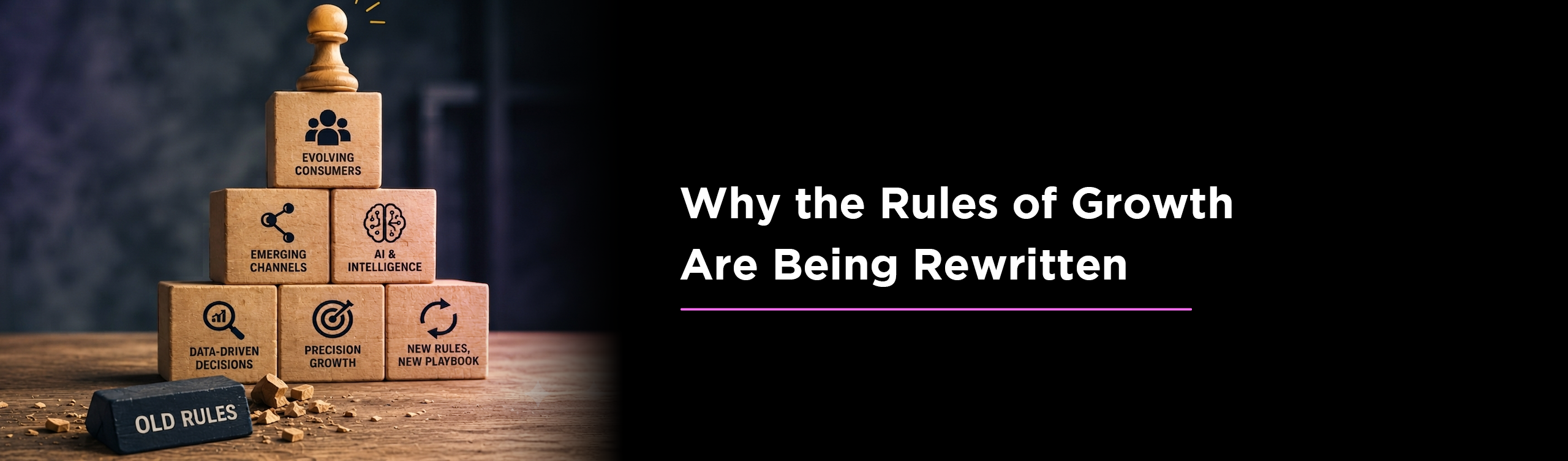
The rewiring is being catalysed by a convergence of multiple seismic developments: the dynamic consumers, the arrival of a truly potent artificial intelligence and the emergence of new channels.
At the enterprise level, this transformation is forcing a re-evaluation of marketing’s role itself. The future will belong to marketing teams that move beyond simply communicating more effectively, and start connecting consumer understanding directly to growth, profitability, pricing power and long-term enterprise value. As marketing becomes more central to business strategy, the discipline itself must also become more rigorous, measurable and accountable.
This shift also demands a new relationship between marketing and finance. For too long, demand creation and capital allocation have operated as separate conversations. The organisations must align consumer understanding with financial discipline and treat growth as a shared responsibility across the enterprise.
Artificial intelligence is accelerating this transformation further- Much of what marketers once considered expertise is rapidly becoming automated. Content creation, optimisation, targeting and execution are increasingly being handled by machines. As execution becomes abundant, judgment becomes scarce. The future value of marketers will be determined less by their ability to execute and more by their ability to make better decisions.
Yet the most profound changes are occurring outside the organisation.
Consumers are evolving faster than many businesses realise- The era of the average consumer is ending. Expectations are rising. Behaviours are fragmenting. Consumers are becoming more informed, more selective and less willing to accept generic propositions. Trust, once treated as a soft brand metric, is increasingly becoming a hard business asset. In a world overflowing with information, credibility is emerging as one of the most important drivers of sustainable growth.
The most successful organisations are learning that growth no longer comes solely from reaching consumers. It comes from creating participation, advocacy and belonging. Communities are evolving from marketing assets into business assets, generating trust, insight and resilience that competitors struggle to replicate.
At the same time, the mechanics of growth are changing – Discovery is increasingly controlled by algorithms, recommendation engines, platforms and AI-powered systems. Consumers cannot choose what they never find. As discoverability becomes a strategic capability, businesses must understand not only how to create demand, but how modern systems surface, recommend and prioritise brands.
The traditional funnel is also losing relevance. Consumers no longer move through predictable linear journeys. They navigate interconnected ecosystems of content, commerce, creators, communities and experiences. In this environment, the organisations that win will not be those that optimise individual touchpoints, but those that orchestrate entire systems.
And as AI continues to democratise targeting, optimisation and personalisation, another challenge emerges.
When every brand can be relevant, what creates lasting advantage?
The answer increasingly lies in meaning. Technology can improve visibility, efficiency. and precision. But it cannot easily create distinctiveness, cultural relevance or enduring memory.
Perhaps this is why many of the boldest predictions discussed at MMA Impact India 2026 ultimately converged around a single idea: the foundations of growth are shifting.
The articles that follow explore these shifts in greater depth. Individually, each examines a specific aspect of growth’s transformation. Collectively, they tell a much larger story.
The rules of growth are being rewritten.
The only question is who will adapt quickly enough to benefit from the rewrite.