
The Industry Landscape
Southeast Asia’s live entertainment market is projected to reach USD 770 million by 2028, with Indonesia consistently holding the largest concert audience base in the region. Live events, however, represent only one segment of a larger picture.
Indonesia’s cinema industry is growing at a CAGR of 9.9%, with domestic productions accounting for 65% of total box office share. That dominance of local content signals a maturing audience base with specific cultural preferences and a production gap that the market is still working to fill. On the brand side, the Southeast Asia experiential marketing sector is forecast to expand from USD 1.2 billion in 2025 to USD 3.8 billion by 2034, driven by consumer preference for in-person, participatory brand interactions.
These segments are growing in parallel. Audiences that attend concerts also go to cinemas and respond to immersive brand activations. The overlap creates both a commercial opportunity and an operational challenge: delivering coherent experiences across formats requires infrastructure that most single-format operators are still building toward.
PK Entertainment Group’s Current Structure and Track Record
PK Entertainment Group, which began as a concert promoter in 2015, has spent the past 11 years doing the latter. It now operates five business units spanning live events, music, film, experiential marketing, and venture capital, a structure that reflects both the company’s strategic direction and the broader fragmentation of how Indonesian audiences engage with entertainment today.
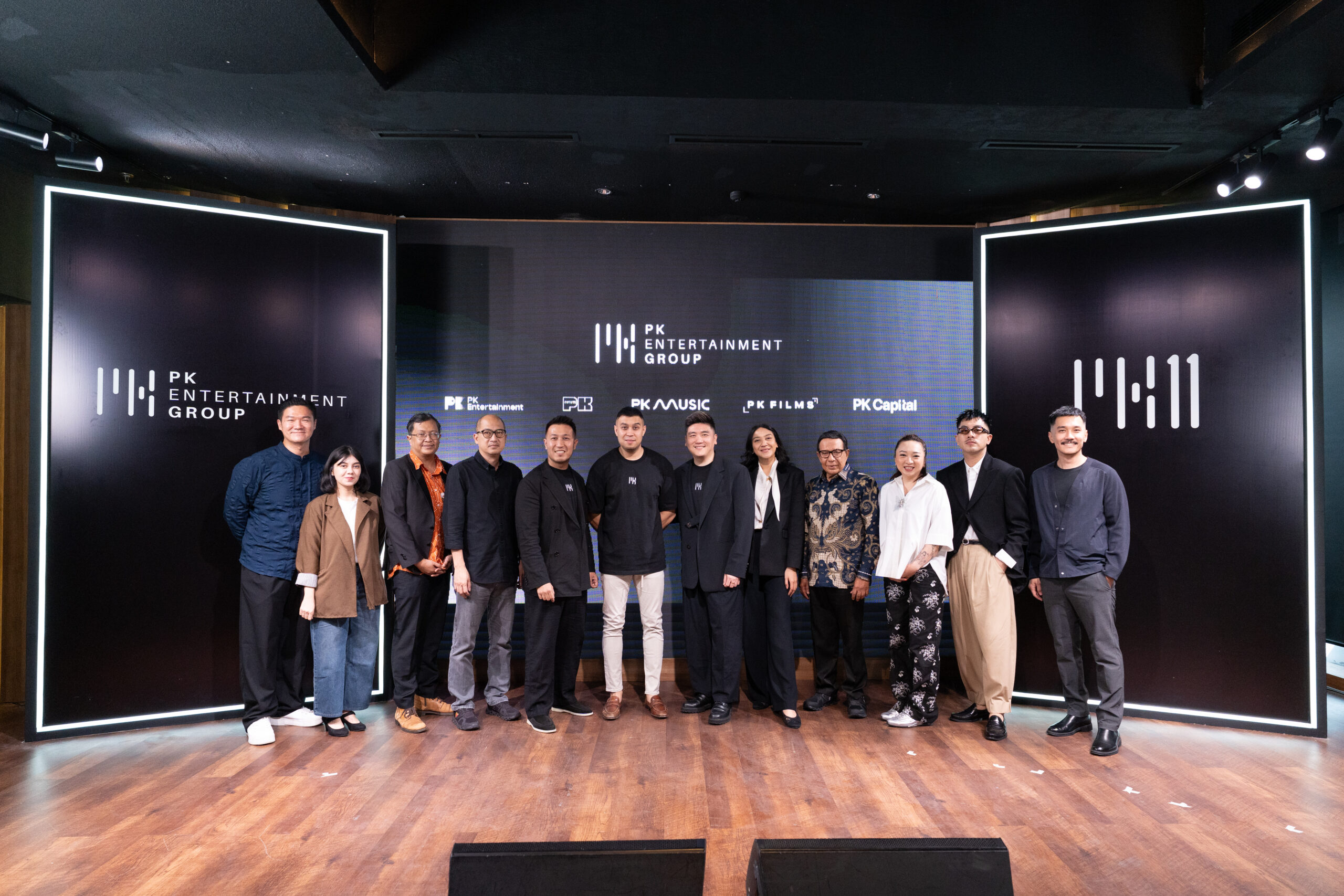
The group’s original concert promotion arm has delivered over 30 international concerts to more than 1 million attendees across Indonesia. PK Events, its corporate production unit, has executed over 500 events for more than 40 multinational clients including Google, YouTube, Meta, and Netflix.
PK Music, focused on local artist development, has co-organized over 50 events in two years and is currently expanding into Singapore and Malaysia. PK Films, the group’s production and co-financing unit, released five titles in 2025 and is targeting over 10 productions in 2026. Confirmed projects include Garuda di Dadaku with BASE Entertainment and Seni Merayu Tuhan with Wahana Kreator, among others. PK Capital, its venture arm, holds investments in youth-oriented creative businesses including Lalala Fest, Milli, Opium, and Juice.
The group operates largely through co-production and partnership structures. Current collaborators include Antara Suara, BASE Entertainment, Wahana Kreator, and MVP Pictures. A newly announced joint venture with CT Corp, K+ Entertainment, will focus on large-scale cultural experiences for Indonesian audiences. Lalala Fest is also preparing to expand to Manila in 2026, with PK Entertainment Group involved in that rollout.
What This Model Reflects About the Industry
The move toward integrated, multi-format entertainment companies is a pattern visible across global markets. Live Nation’s acquisition of Ticketmaster, CJ ENM’s cross-sector presence in South Korea spanning music, film, and e-commerce, and the ongoing consolidation among Southeast Asian media groups all point to the same underlying logic: audience attention is the scarce resource, and operating multiple access points to that attention reduces dependency on any single format.
In Indonesia, the conditions are particularly favorable for this kind of consolidation. A young, urban population with rising disposable income, a domestic film industry that has demonstrated strong competitiveness on home turf, and a live events market that has recovered strongly post-pandemic together create a market where integrated operators can extract compounding value across the entertainment cycle.
The risks are proportional to the scale of ambition. Managing five business units across live events, film, music, production, and investment simultaneously requires organizational depth that is difficult to sustain during rapid expansion. The 2026 pipeline, comprising over 10 film releases, international concert tours, a new joint venture, and regional market entry, is a significant test of that capacity.
Whether PK Entertainment Group’s multi-unit model becomes a reference point for Indonesia’s creative industry will depend on execution consistency across all fronts as the organization scales.
Why Indonesia’s Next Entertainment Giants Will Be Ecosystems
Indonesia’s entertainment market is converging across formats
Live entertainment is projected to hit USD 770 million by 2028. Domestic films hold 65% of box office share, growing at 9.9% annually. The experiential marketing sector is set to triple from USD 1.2 billion to USD 3.8 billion by 2034. These segments are growing in parallel, and audience behavior is already crossing all three. Single-format strategies are increasingly leaving revenue on the table.
Integrated, multi-format operators are gaining structural advantage
Global precedents show that companies controlling multiple audience touchpoints across live, film, and brand experiences generate compounding returns over time. As Indonesia’s entertainment segments converge, operators with cross-format infrastructure are better positioned to capture value across the full audience lifecycle.
Partnership-driven models are the dominant expansion strategy in Southeast Asia Across the region, co-production and collaboration structures are proving more viable than full ownership, particularly in fragmented markets where speed and local relationships matter. Asset-light expansion through strategic partnerships is emerging as the preferred playbook for scaling across Southeast Asia.
Local content is a durable audience preference, not a phase
With domestic productions capturing 65% of Indonesia’s box office, local storytelling has proven it can compete on its own terms. Companies building local content pipelines now are ahead of a structural shift, not reacting to one.
Southeast Asia’s creative IP is shifting direction
The region’s entertainment flow is reorienting. Indonesian-originated music, film, and live experiences are increasingly finding audiences across Southeast Asia, reflecting a broader pattern where local creative industries are scaling regionally rather than remaining domestic.