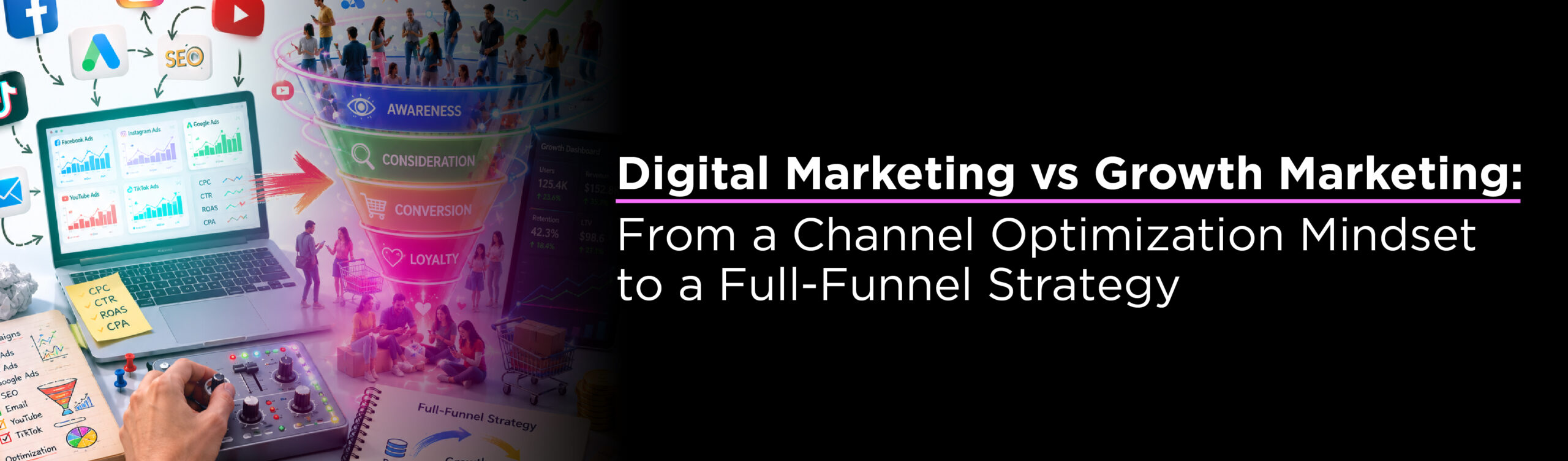
One fine morning, your boss walks into the meeting room and throws a tough puzzle your way: “Our ad spend this month jumped by 50%, but the actual orders coming from our existing customer base dropped by half. Look into this and see how we can optimize our digital channels.”
If the very first answer that pops into your head is: “Let me increase the budget to test some new target audiences on Facebook, or hire a few TikTokers to make viral clips to drive traffic back” – then congratulations, you are thinking purely within the traditional track of Digital Marketing.
It is not a wrong answer, but it is far from enough. It is like seeing a wilting tree and trying to spray more water on its leaves, while the real issue is that the roots have run out of nutrients.
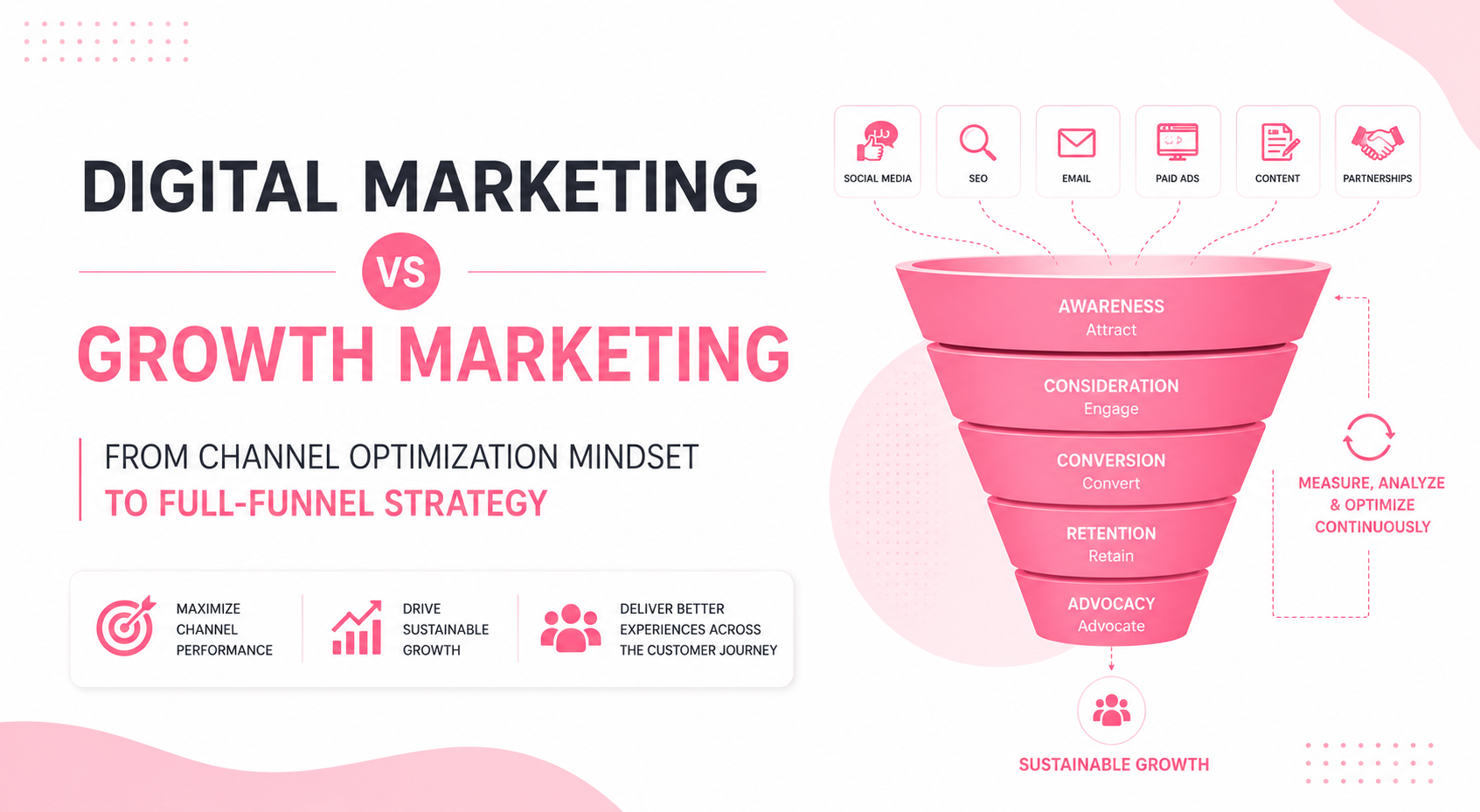
Many professionals still mistake Digital Marketing and Growth Marketing for the same thing, or think Growth is just a trendy buzzword for ad buyers. That is not the case. One is about finding the right tools to reach customers; the other is about designing the entire journey to retain them and generate sustainable cash flow.
If you want to break away from short-term campaigns and build a real growth engine, this article is for you. We will dissect these two concepts from a highly practical perspective, leaving all the fluff behind.
- The Core Game: Traffic Acquisition vs. Value Retention
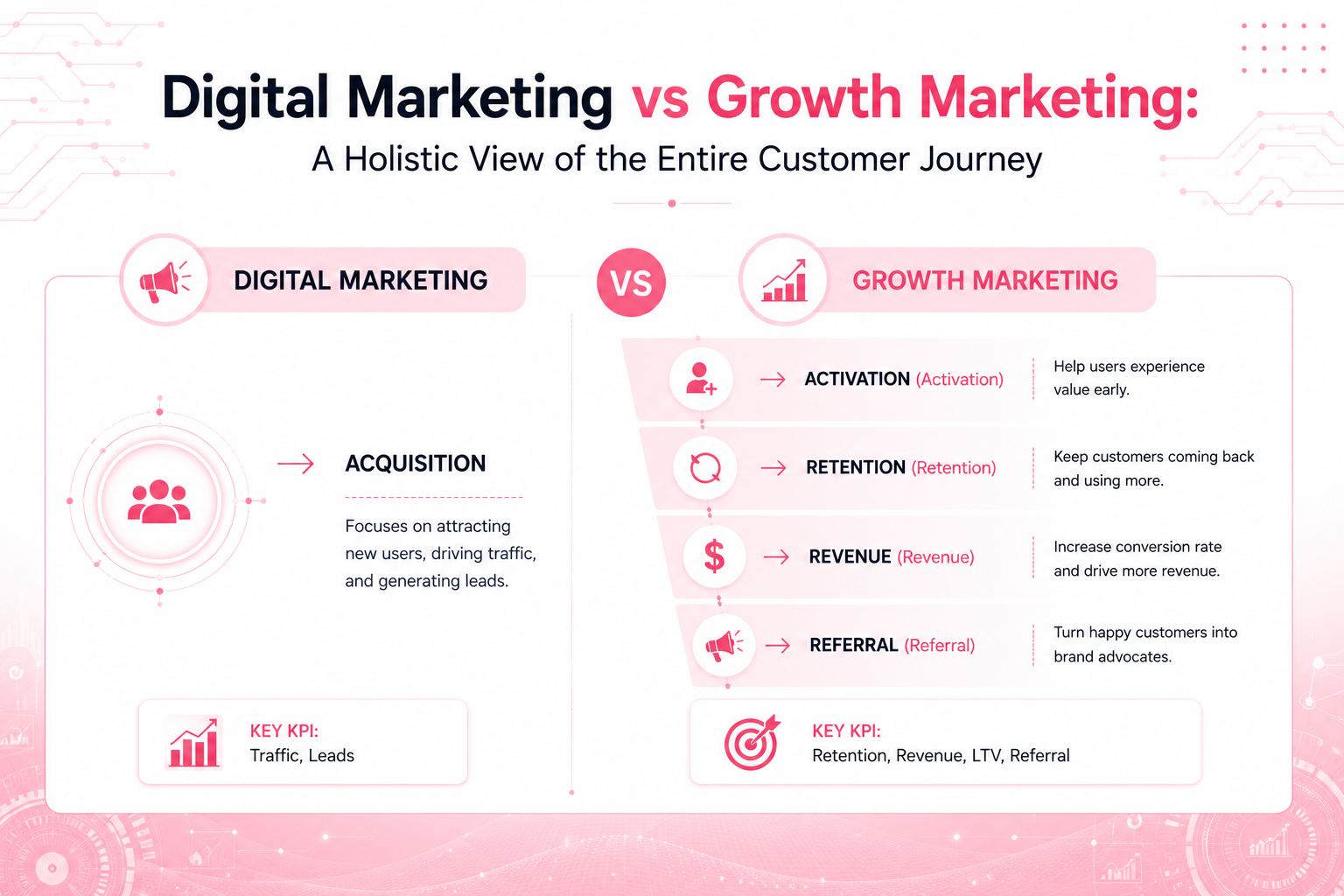
To tell them apart most clearly, look at how these two concepts approach the conversion funnel. In marketing, we frequently refer to the AARRR funnel framework (comprising 5 stages: Acquisition – Activation – Retention – Revenue – Referral).
Digital Marketing: The Doorman Who Brings Customers Inside
Fundamentally, Digital Marketing pours all its energy into the top of the funnel (Acquisition). The ultimate goal of a Digital Marketer is to get the brand’s message in front of the right people at the right time, prompting them to take a specific action online: click a link, fill out a registration form, or hit the send message button.
To achieve this, they utilize an ecosystem of online tools:
- Paid Channels: Facebook Ads, Google Ads, TikTok Ads for rapid coverage.
- Organic Channels: Website SEO, Social Content Creation to nurture organic traffic.
- Influencer Marketing: Booking KOLs/KOCs to leverage their existing fan bases.
Metaphorically speaking, Digital Marketers are brilliant flyer distributors in the virtual world. They know exactly which intersections are the busiest, where to hand out flyers so people will actually grab them, and how to drive crowds into your store. But once the customer steps through that door, the rest of the story falls completely outside their control.
Growth Marketing: The Architect of the Journey
Growth Marketing steps in to bridge the gap that Digital Marketing leaves behind. They do not just care about how many people click on a website; they look at the entire journey that follows (Full-funnel).
When 10,000 users land on a page (the result of the Digital team), a Growth Marketer starts analyzing the data:
- Why do 70% of users bounce within the first 3 seconds? Is the UI confusing or is the copy missing their pain points? -> Optimizing Activation.
- Once a customer makes their first purchase, how do we get them to return next month without spending another dime on advertising? -> Optimizing Retention.
- How can we embed a small loop into the product experience that makes users so delighted they naturally share it with friends? -> Optimizing Referral.
Growth Marketing views marketing and the core product experience as inseparable. They are willing to tweak product features, restructure user onboarding flows, or set up automated trigger systems just to lift conversion rates by 1% at every stage of the funnel.
-
Three Core Differences: Shifting Perspectives, Changing Outcomes
If you put a Digital Marketer and a Growth Marketer in the same room, you will notice a stark contrast in how they think, act, and interpret numbers.
Difference 1: Campaign-Based Execution vs. Rapid Experimentation
Traditional Digital Marketers live and breathe by campaigns. You have your New Year campaign, Summer campaign, Brand Anniversary campaign, and so on. Each comes with a fixed budget, pre-produced visual assets, and a defined channel allocation plan. Once the campaign ends, they measure the results, wrap it up, and move on to the next one.
Conversely, Growth Marketing operates on Rapid Experimentation. They do not wait for a major campaign. Every week, a growth team might run 5 to 10 micro-tests based on incoming data.
Example: They notice a high drop-off rate at the checkout step. They immediately form 3 hypotheses and launch A/B tests:
- Test A: Changing the “Checkout Now” button to a high-contrast orange.
- Test B: Adding a “Free Shipping on this order” line right beneath the total price.
- Test C: Shortening the checkout form from 4 steps down to 2.
They run these tests with minimal budget and on a limited user segment. Whichever variant yields the highest conversion lift is integrated and scaled across the entire system. For them, growth does not stem from a single explosive idea, but from the compounding effect of hundreds of micro-optimizations.
Difference 2: The Battle of Metrics – Vanity Metrics vs. The North Star Metric
The next big divide lies in the metrics used to report to leadership at the end of the month.
Digital Marketing often gets caught up in Vanity Metrics. These include impressions, reach, video views, social follower counts, or ad clicks. While these figures look impressive on a slide deck and give the illusion of brand popularity, they cannot sustain a business if the actual purchase conversion rate sits at zero.
Growth Marketing is much more pragmatic. They ignore the vanity metrics to hunt for a North Star Metric—the single metric that best captures the core value your product delivers to its customers and reflects the true health of the business.
- For a social app, it is not total downloads, but Daily Active Users (DAU).
- For an e-commerce platform, it is the Repeat Purchase Rate within 30 days.
They constantly balance two core financial metrics: CAC (Customer Acquisition Cost) and LTV (Lifetime Value). If a Digital Marketer celebrates acquiring 1,000 cheap leads this month, but the Growth Marketer points out that 90% of those leads churned after week one (resulting in a dismal LTV), the growth team still classifies that campaign as a failure.
Difference 3: Independent Silos vs. Cross-Functional Collaboration
In older organizational models, the marketing department operates in isolation. They receive briefs from the Product or Sales teams: “We have this new feature rolling out this month, go put together a media plan.” The Digital team takes the info, writes the copy, designs the banners, sets up the ads, and hands the leads over to Sales. If the product breaks or Sales fails to close, fingers start pointing.
Growth Marketing smashes these silos. A standard Growth Team is cross-functional by design, typically embedding a marketer, a data analyst, a product designer, and an engineer into a single tight-knit unit.
They huddle weekly to tackle a single shared objective. If a broken registration loop on the website frustrates users, the embedded engineer fixes the source code right then and there, skipping the bureaucratic IT helpdesk tickets that take weeks for approval. They hold the mandate to intervene anywhere that impacts user experience.
-
The Power of Centralized Data: The Foundation for Growth
To shift effectively from a siloed channel mindset to an integrated full-funnel strategy, a growth team requires one critical element: Unified Data.
If your data remains fragmented—where Facebook handles ad clicks, the website tracks traffic separately, and customer purchase histories are buried deep inside a legacy sales database—executing growth experiments becomes nearly impossible. You cannot figure out whether a customer acquired through TikTok Ads yesterday returned to buy a second time today.
This is precisely where modern technology infrastructures, such as CNV CDP, become essential. By consolidating all touchpoints—from the first ad interaction to post-purchase loyalty behavior—into a centralized Customer Data Platform, the boundaries between Digital and Growth are seamlessly bridged. Instead of guessing, the team gains a clear, real-time map of the entire customer lifecycle, giving them the exact data points needed to run precise, high-impact experiments.
-
The Symbiotic Reality: Digital is the Muscle, Growth is the Brain
When Growth Marketing first surged in popularity, a wave of debate claimed that Digital Marketing was obsolete and bound for replacement. This is an extreme and unrealistic view. In truth, these two concepts do not oppose each other; they are perfect evolutionary pieces.
Think of your marketing infrastructure as a racing car:
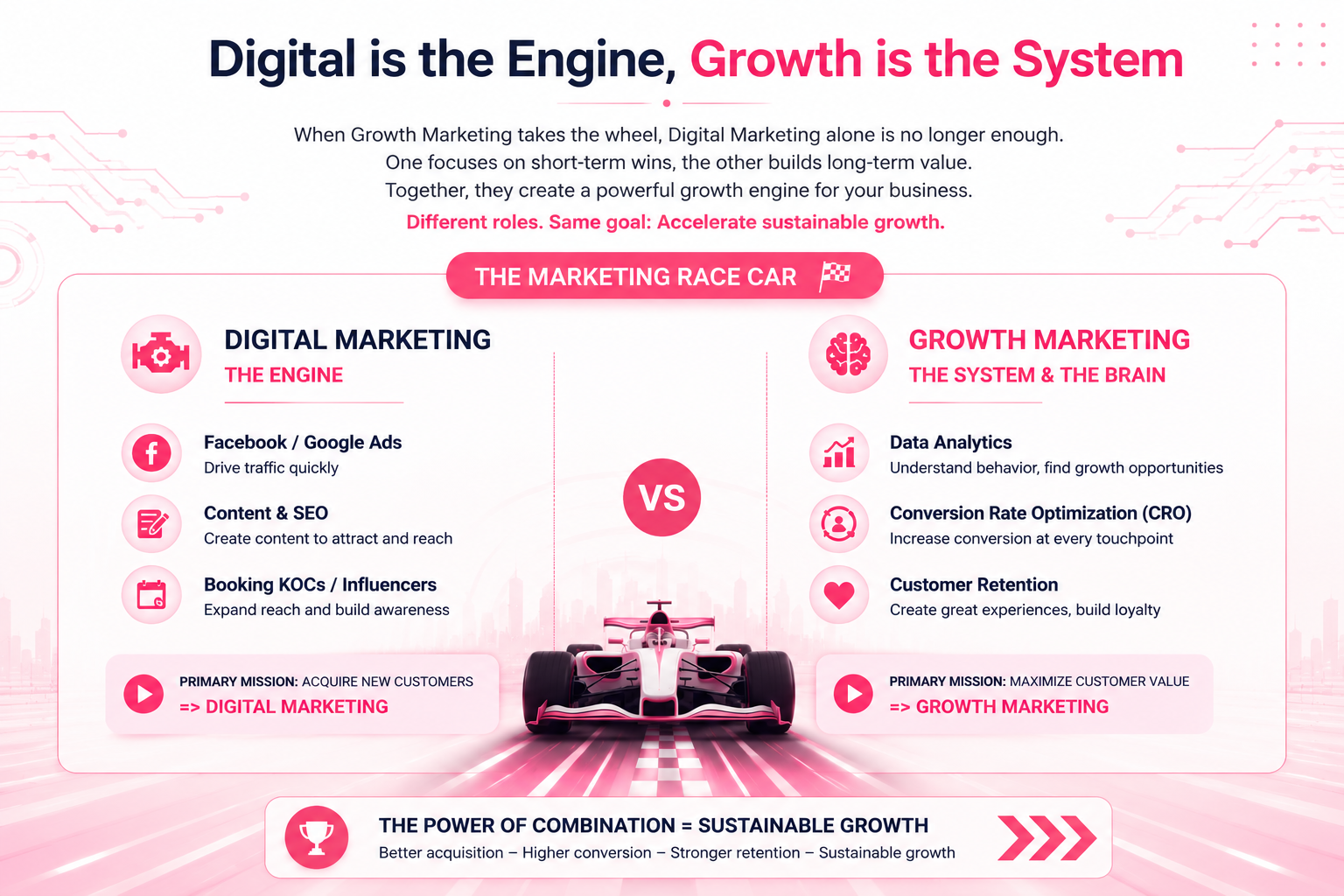
Without Digital Marketing providing the pure horsepower to pull the car forward, you will have zero traffic. No one discovers your brand, your data systems remain empty, and you have absolutely nothing to analyze or optimize. You could have an exceptional product with an incredibly slick onboarding flow, but if no one knows how to find your website, it all goes to waste.
Conversely, if you only have a powerful engine (running ads brilliantly) but your car lacks an intelligent operating system to regulate fuel efficiency, causing leaks at every joint (lacking a Growth mindset), the vehicle will burn through its budget long before crossing the finish line.
- The Evolution Roadmap: When Does Your Business Need What?
You do not need to hire an extensive growth team with expensive automation software on day one of your business. The right framework depends entirely on your product’s current stage of maturity.
Stage 1: Finding Product-Market Fit (PMF)
When you are launching a brand-new product or service, your primary objective is to prove that the market actually wants what you are selling.
During this window, lean heavily on Digital Marketing. Allocate your budget toward visibility ads and broad content distribution to test market reactions. Measure whether users are enthusiastic enough to leave their contact details, look at what questions they ask, and identify which demographic responds most positively. This stage requires raw speed and reach to build an initial baseline of data.
Stage 2: Scaling Up & Maximizing Capital Efficiency
Once you have secured a steady stream of initial customers, you will likely hit a harsh reality: your Customer Acquisition Cost (CAC) starts climbing due to market competition, while the revenue generated from each customer fails to offset operational overhead.
This is the golden hour to activate your Growth Marketing Operating System. Pause the reckless ad spend increases and look inward at your system to execute optimization strategies:
- Conversion Rate Optimization (CRO): How do we keep the incoming traffic constant at 1,000 visitors, but lift the number of actual buyers from 10 to 30?
- Marketing Automation: Establish automated triggers via email or direct messaging channels to follow up on abandoned carts, or send personalized birthday tokens that incentivize a second purchase.
- Viral Loops: Design referral mechanics such as “Give $5, Get $5 on the first successful order”. This turns your existing customer base into an organic acquisition channel, slashing your reliance on paid media.
Conclusion: The Choice Lies in Your Objectives
The comparison between Digital Marketing and Growth Marketing is not about crowning one winner over the other. It comes down to how you want your business to operate in the coming years.
If your objective is strictly short-term—such as liquidating inventory over a single month or driving a rapid spike in brand awareness for an upcoming event—hand the keys over to a seasoned Digital Marketing team.
But if your goal is to construct a self-sustaining business engine, where every dollar spent today builds equity for tomorrow, and every strategic decision is illuminated by real-world data—it is time to upgrade your infrastructure to Growth Marketing. Stop focusing only on the visible channels on the surface. Start looking at the whole funnel, test small, learn fast, and turn marketing into a genuine revenue generator rather than just a department that spends money.