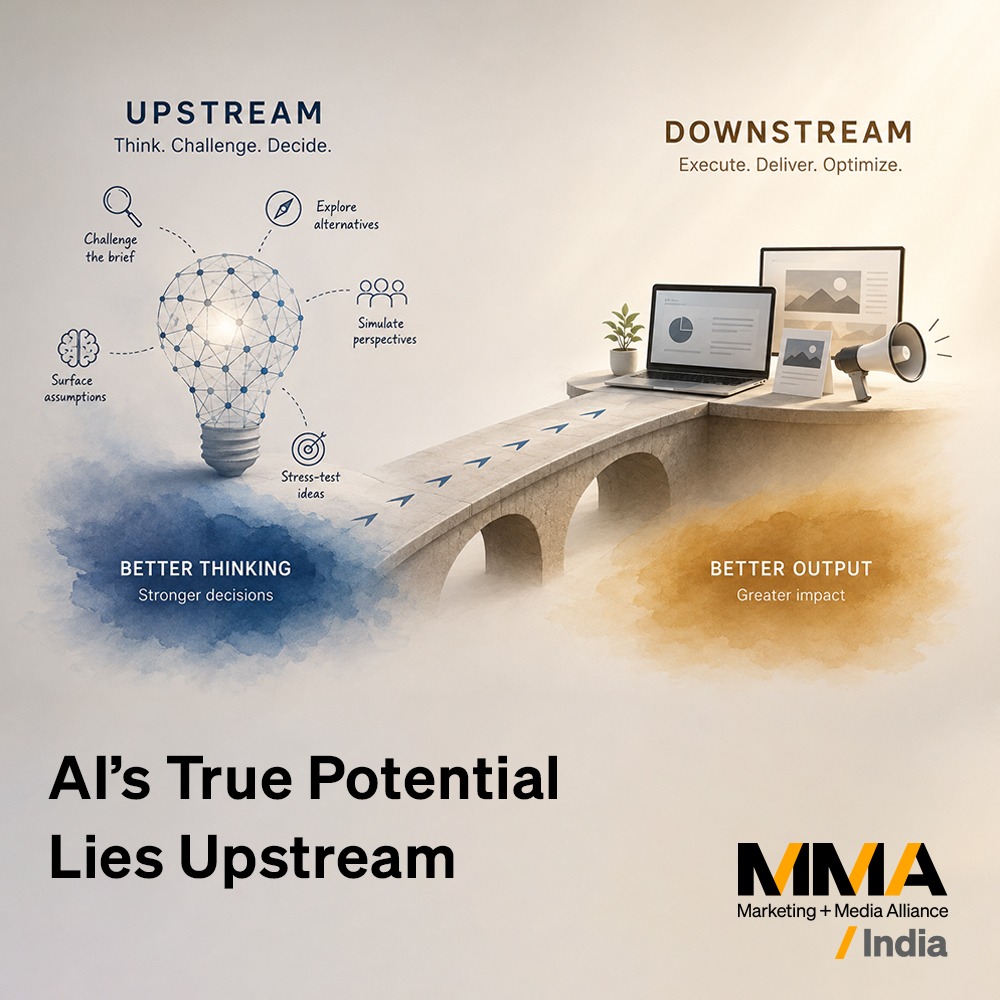
In the age of infinite creative scale, coherence is the new competitive advantage.
We solved the wrong problem.
For years, the creative bottleneck in marketing was production. Not enough time, not enough budget, not enough hands to build everything a campaign needed across formats, markets, and audiences. Generative AI fixed that. Thousands of variants. Multiple languages. Platform-ready in minutes. The production constraint is gone.
But a new problem walked in through the same door. And most marketing leaders haven’t named it yet.
The problem is drift.
At MMA Global, we’ve been watching this play out across markets in APAC and beyond. Our colleagues at Marketing TNT put it sharply in a recent piece on creative control: when variation becomes infinite, small inconsistencies compound. Tonal drift. Context drift. Cultural drift. None of it dramatic in isolation. All of it consequential at scale.
The brand doesn’t change overnight. It shifts — variant by variant, optimisation cycle by optimisation cycle — until one day the creative feels subtly but unmistakably off. And by then, the damage is structural.
1. Optimisation Without Guardrails Is a Slow Brand Erosion
AI systems optimise toward the signals you give them. If those signals are narrow — click-through rate, immediate conversion, cost per acquisition — the system will find its way there. And in doing so, it will quietly trade away everything that isn’t measured.
Subtlety. Restraint. Emotional nuance. Brand distinctiveness.
This is not a technology failure. It is a leadership failure. The machine did exactly what it was told. The question is whether we told it the right things.
Across MMA Global’s Consortium for AI Personalization (CAP) pilots, the evidence is consistent: structured creative inputs outperform unconstrained generation. Brands that pre-defined narrative boundaries, controlled variation tiers, and optimisation guardrails before scaling saw performance lifts exceeding 100% on defined KPIs. In some cases, as high as 259%. The gains came not from producing more, but from defining better.
More variants is not the answer. More clarity is.
2. APAC Makes This Harder — and More Urgent
Nowhere is creative drift more operationally complex than across Asia Pacific.
The diversity of language, culture, platform behaviour, and consumer expectation across our region means that localisation at scale is not a translation exercise. It is a brand interpretation exercise. And when AI handles that interpretation without sufficient guardrails, the risk is not just tonal — it is cultural.
A brand built on restrained, relationship-driven messaging in one market can find its AI-generated variants becoming more direct, more promotional, more transactional in another — not because anyone decided that, but because the optimisation logic learned what performs locally.
Multiply that across Vietnam, Indonesia, India, the Philippines, and Thailand simultaneously, and you don’t have a localisation strategy. You have brand fragmentation running on autopilot.
The leaders getting this right in APAC are not those with the most creative output. They are the ones who invested first in what I’d call strategic encoding — the precise articulation of what the brand is, what it cannot become, and which performance signals are allowed to influence messaging. That clarity becomes the constraint that makes scale safe.
3. Creative Leadership Has a New Job Description
The CMO’s relationship with creative has fundamentally shifted. And I think many leaders are still operating with the old model.
Creative leadership used to mean reviewing executions. Approving campaigns. Giving feedback on copy and visual. That model assumed a human being touched every significant output before it went live.
That assumption is no longer valid.
When AI generates and optimises creative continuously, the locus of control must move upstream. From outputs to inputs. From reviewing what was made to defining the parameters within which things are made.
This means creative leadership is now an architectural discipline. What elements of the brand are fixed regardless of context? What can adapt without altering positioning? Where does optimisation stop and brand intent take precedence? These are not creative briefs. They are systems design decisions.
The organisations winning at creative AI are treating their brand not as a campaign idea but as a set of structured inputs that machines can interpret consistently — across formats, markets, and moments.
Build the system right, and automation strengthens coherence. Build it wrong, and you’ve handed a high-speed engine to a driver without a map.
The Control Imperative
In 2026, creative advantage is less about how much you can produce and more about how clearly you’ve defined what you stand for.
The brands that will build lasting equity through AI are not the ones generating the most variants. They are the ones with the clearest brief for the machine — and the discipline to hold that line when optimisation pressure pushes in another direction.
Scale is now a commodity. Coherence is the edge.
I’d be curious to hear from others leading this across APAC — where are you drawing the line between what AI can optimise and what must stay fixed? What’s working?
#CreativeControl #AIInMarketing #BrandStrategy #GenerativeAI #MarketingLeadership #CMOAgenda #MMAGlobal #MMAImpact2026 #CreativeAI #MarketingScience