
TikTok has become core media across APAC and increasingly the platform where attention, intent, and discovery converge. In Vietnam alone, TikTok now reaches 76.1 million adults aged 18 and over, equivalent to 88.8 percent of the country’s internet user base (1). Every day, millions move through the platform discovering products, trends, advice, and entertainment. Attention is everywhere. So is competition.
According to the Silverpush TikTok Context Advantage Report, while reach continues to scale, performance is increasingly determined by how well brands align with the context of consumption rather than the demographics of the audience.
Across 80+ campaigns in nine APAC markets and twelve verticals, the report reveals a consistent pattern: the cohort the algorithm serves at scale is rarely the cohort that converts, and a single platform benchmark across markets, verticals, and objectives misleads more than it informs. The challenge is no longer access to TikTok’s audience. It is precision in the moments where intent lives.
TikTok’s Cohort Trap
Most TikTok plans still index toward 18 to 24. Budgets follow that assumption, creative is briefed for short attention spans, and success is measured against one platform-wide benchmark. But the audience of 2026 is not the audience of 2021. The 35 to 44 cohort on TikTok is now growing 41 percent year on year globally, faster than any other age band (1).
The result is misplaced spend.
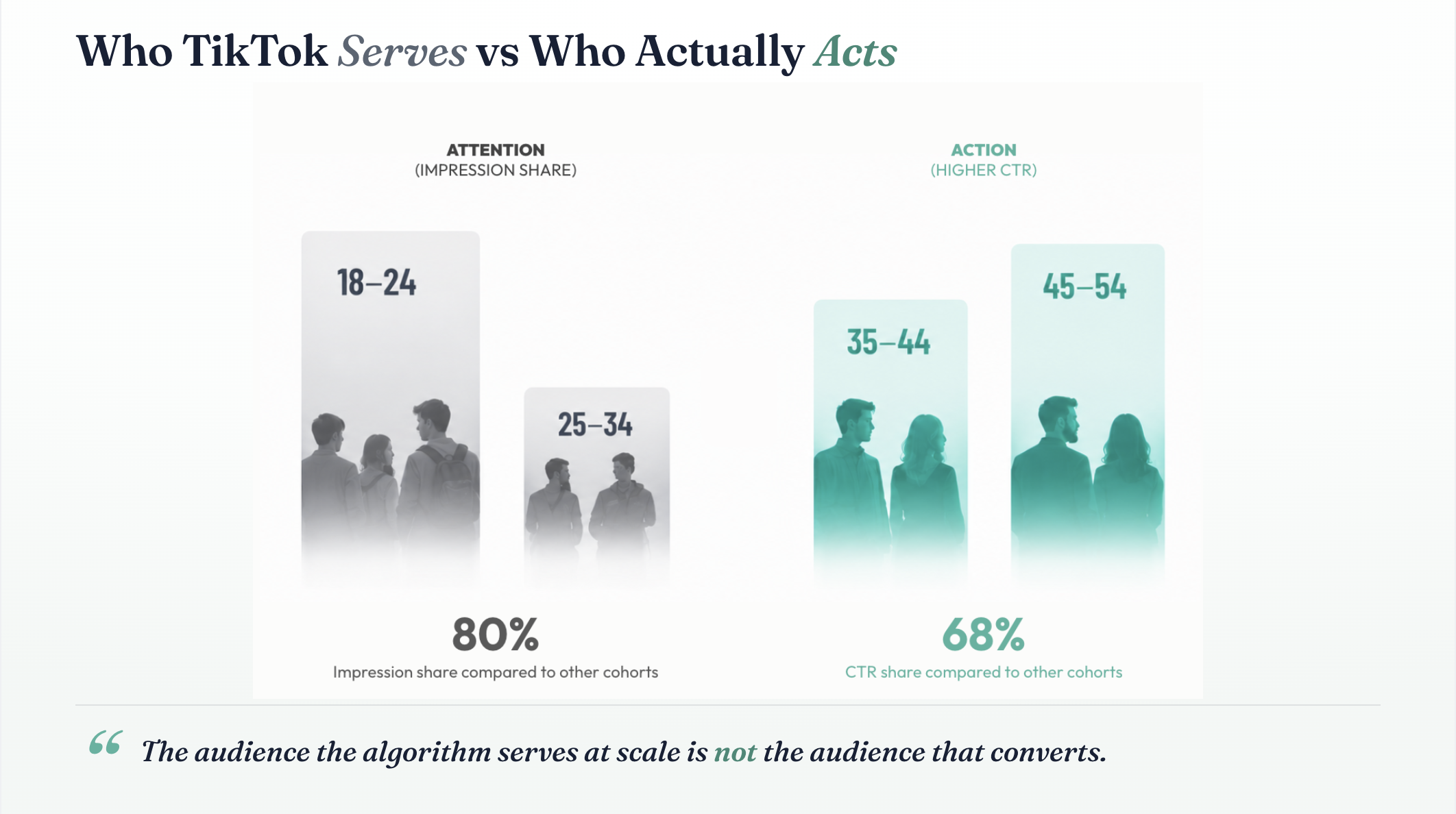
Impression share versus click-through share by age cohort, based on Silverpush’s TikTok Context Advantage Report
The market evidence repeats the pattern. In Malaysia, a men’s grooming brand’s 35 to 44 cohort delivered three times the planned CTR. In Vietnam, a nutrition brand’s highest CTR came from the 55+ cohort, 2x against the benchmark, when messaging was benefit-led. And across APAC, only 36 percent of 45 to 54-year-olds say they are conserving income, compared with 59 percent of 18 to 29-year-olds (1). The cohort the algorithm overdelivers to is also the one with less to spend.
How Context Becomes the Audience Advantage
The Silverpush TikTok report shows that performance improves when brands align to the moment, not just the audience. That means combining content context, engagement intent, and campaign objectives, then activating through platform-native signals such as hashtags, interests, and contextual placements.
On TikTok, context follows the brief. Technology campaigns won when a 15-second teaser handed the story off to the destination page. The intent was already formed, and longer creative diluted rather than deepened it. Automotive awareness moved the other way: 6-second creative held attention longer than any other format, with a Vietnam-specific signal showing KOL-led long-form variants outperforming thematic assets when a credible voice carried the story. CPG and food, rooted in cooking, family, and cultural moments, were the strongest-performing vertical in the dataset.
This is contextual planning at work: signals over segments, moments over demographics, briefs over benchmarks.
Format and Metric Play Different Roles
TikTok’s most repeated myth, “keep it under 15 seconds,” does not hold across the data. Long form beats short form for awareness in native contexts. Short form beat long form for traffic. What held consistently was concurrence: campaigns that performed most reliably ran five to seven creatives across multiple durations in parallel, refreshed every two weeks, with each cut doing a different job from hook to story to native execution.
Measurement has to keep up. A high CTR with moderate VTR is not a failure. It is the fingerprint of a hook-driven traffic campaign that worked. Held to a VTR benchmark, the same campaign looks weak. The most effective TikTok strategies match metric to mission rather than judging every campaign against one line.
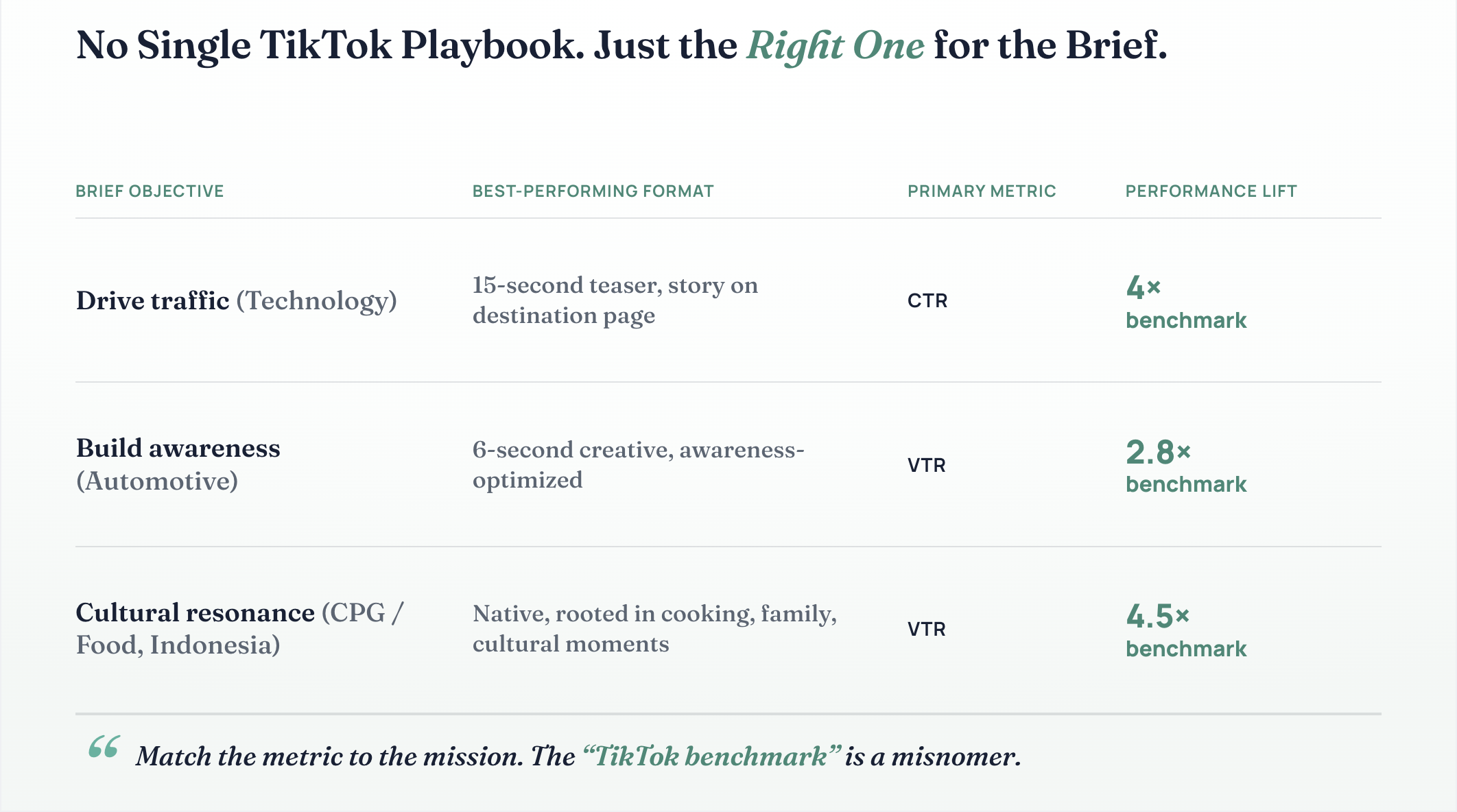
How creative duration, format, and metric align to objective, based on Silverpush’s TikTok Context Advantage Report
As TikTok matures into a primary commercial channel across APAC, success will depend less on chasing the algorithm’s biggest audience and more on planning against the moments where intent lives. Brands that map context, creative, and metrics together spend smarter and compound learnings across briefs. When the same contextual setup ran twice for the same brand in the same market, performance landed within a two-point band. That is the signature of a system, not luck.
On a platform defined by speed, signals, and shifting attention, context is the real performance multiplier.