Retail media has become one of the fastest-growing sectors in advertising, reshaping how retailers monetize data, inventory, and shopper relationships. Global retail media ad spending is projected to reach $62 billion in 2026, making it the third-largest digital advertising channel globally. In the U.S. alone, advertisers are expected to spend $71.09 billion on retail media in 2026, growing 17.8% year-over-year and outpacing both social and search advertising growth.
But much of the conversation around Retail Media Networks (RMNs) still centers on digital environments – sponsored search, onsite display, offsite targeting, and closed-loop ecommerce attribution.
That focus obscures a larger reality: a significant share of shopper influence still happens inside physical stores.
Endcaps, aisle displays, digital screens, cooler doors, checkout placements, and in-store activations continue to shape purchase behavior at scale. Yet compared to digital RMNs, these environments remain far less measurable. Retail media may be evolving rapidly online, but some of its most commercially influential inventory still exists in physical retail spaces where attribution confidence remains significantly lower.
This is becoming the next major challenge for retail media.
Because as retailers increasingly treat stores as monetizable media environments rather than purely transactional spaces, the question is no longer whether in-store retail media matters. It is whether the industry can measure its influence with enough precision to value, optimize, and scale it effectively.
Why In-Store Measurement Has Been So Difficult
Digital retail media was built around deterministic signals. Impressions, clicks, purchases, and conversions could be linked directly within controlled environments, creating a relatively clear chain between exposure and outcome.
Physical retail environments operate differently.
A shopper moving through a store generates fragmented and probabilistic signals rather than deterministic ones. Exposure itself is difficult to define consistently. A consumer walking past a digital screen, shelf display, or branded endcap does not necessarily mean they saw it, processed it, or changed their behavior because of it.
That distinction matters because one of the core challenges in physical retail environments is that exposure alone is an incomplete signal. The challenge is not simply detecting presence. It is estimating influence.
This complexity compounds quickly inside stores. Multiple shoppers share the same environment simultaneously. Purchase decisions unfold across categories, aisles, and moments of consideration that may not follow predictable paths. Behavioral signals are often delayed, partial, or disconnected from the original exposure point altogether.
The Store Is Becoming a Measurable Signal Environment
The next phase of retail media is not simply about expanding inventory. It is about expanding measurement infrastructure inside physical retail spaces.
Stores themselves are becoming increasingly data-rich environments.
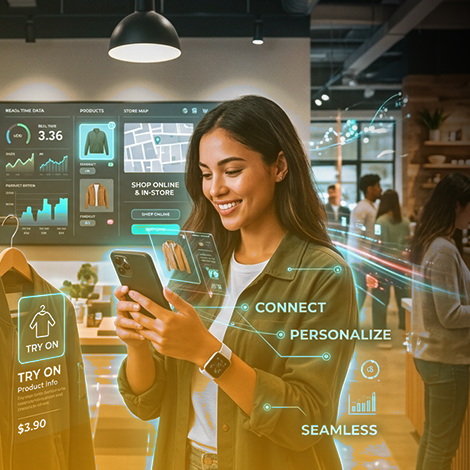
Retailers are now combining multiple layers of signal capture, including loyalty systems, POS data, mobile proximity signals, WiFi telemetry, shelf sensors, and computer vision, to better understand how shoppers move, dwell, engage, and convert within stores.
The objective is no longer simply to measure transactions. It is to measure influence inside the store itself.
This represents a meaningful shift in how physical retail environments are understood commercially.
The market trajectory reinforces this shift. Despite the scale of physical retail influence, only 0.7% of retail media ad spending currently goes toward in-store media environments. But that share is projected to grow 45.5% next year and exceed $1 billion by 2028, signaling that retailers and advertisers increasingly see physical store environments as the next major frontier for retail media monetization.
AI Is Becoming the Interpretation Layer
What makes this transformation possible at scale is not simply the collection of more data. It is the ability to interpret fragmented physical-world signals with greater intelligence.
This is where AI is beginning to play a critical role.
Physical retail environments generate enormous amounts of noisy and incomplete behavioral data. Computer vision systems may estimate exposure probability near displays. Telemetry systems may detect shopper movement patterns and dwell time. Loyalty systems may connect purchases back to households or transaction histories. But none of these signals alone fully explain exposure effects.
AI increasingly functions as the interpretation layer across these fragmented inputs.
Machine learning systems can identify patterns between exposure zones, movement behavior, basket composition, repeat visitation, and purchase probability in ways that would be difficult to operationalize manually. Instead of relying on single-point attribution, retailers can begin modeling directional relationships between store experiences and behavioral outcomes.
This broader shift toward probabilistic and causal measurement models is also becoming increasingly visible across the industry’s wider marketing measurement conversations. MMA’s Brand as Performance (BAP) initiative, for example, has emphasized the importance of measuring influence beyond immediate transaction signals alone, focusing instead on incremental behavioral impact over time. The same logic is beginning to shape how retailers think about physical media attribution: not simply whether an exposure occurred, but whether it meaningfully contributed to changes in shopper behavior.
The important distinction is that in-store attribution is unlikely to become perfectly deterministic. The opportunity is to make it directionally intelligent enough to influence planning decisions confidently.
That shift changes the role of measurement itself.
The goal is no longer absolute certainty around every shopper interaction. It is building enough causal confidence to improve inventory valuation, optimize placements, refine creative environments, and strengthen retail media planning decisions over time.
Why In-Store Measurement Matters Strategically
The significance of in-store measurement extends well beyond reporting accuracy.
For marketers, the larger shift is that physical retail environments are beginning to generate the kind of behavioral intelligence that has historically been easier to capture online. That changes how influence across the shopper journey can be understood, particularly in categories where purchase decisions are still heavily shaped inside stores.
Marketers gain a clearer understanding of how physical exposure contributes to basket behavior, category movement, purchase timing, and incremental lift across the broader commerce ecosystem. The implication is not simply better reporting. It is better decision-making around where influence actually happens.
This becomes increasingly important as advertisers place greater scrutiny on incrementality, omnichannel attribution, and return on media investment. In-store measurement has the potential to close one of retail media’s largest visibility gaps, helping brands understand not only what drove conversion online, but how physical retail environments shaped behavior before the transaction occurred.
That changes how retail media itself gets valued strategically.
The future advantage for marketers may not come from accessing more retail media inventory alone, but from understanding how digital and physical influence work together across the shopper journey.
The Store Is Becoming Media Infrastructure
Retail media’s next phase may not be defined by more sponsored listings, more onsite placements, or even more inventory. It may be defined by the industry’s ability to understand influence more completely across the shopper journey, including the moments that happen inside physical retail environments.
For marketers, that changes the role of Retail Media Networks fundamentally.
RMNs are no longer just commerce advertising channels optimized around conversion events. Increasingly, they are evolving into broader influence systems, environments capable of connecting exposure, behavior, movement, attention, and transaction signals across both digital and physical touchpoints.
That shift matters because some of the most commercially important moments in retail still happen before a transaction becomes measurable online. As in-store environments become more instrumented and attributable, marketers gain a clearer view of how physical and digital influence work together rather than as isolated parts of the media mix.
The strategic advantage will not come from accessing more retail media inventory alone. It will come from understanding which environments genuinely shape behavior, where influence compounds across channels, and how media decisions can be optimized around that broader view of consumer movement.
The future of retail media may depend less on measuring clicks in isolation, and more on measuring influence wherever the shopper journey actually unfolds.