
The MMA x Decision Lab benchmark identifies the clearest white space in the region, with agentic AI barely deployed even by the leaders, which means the 2026 race starts close to level.
Most competitive advantages in marketing arrive late. By the time a capability is proven, the field has already moved, the cost of entry is high, and the return is thin. You are buying into a market that has already priced the advantage in.
The State of AI in Marketing 2026: Southeast Asia, from the Marketing + Media Alliance (MMA) and Decision Lab, has found the rare exception. On agentic AI, the region’s most advanced marketers are barely ahead of everyone else, and the gap is small enough to close inside a single planning cycle.
The numbers that define the opportunity
General AI adoption in Southeast Asia is mainstream. 57% of marketers sit at an advanced maturity stage, 80% include AI in their marketing plans at a moderate level or higher, and benchmarked against US and global averages the region is ahead on scaling, with 46% already scaling or fully scaled.
Agentic AI is a different picture entirely.
| Agentic AI status | Advanced adopters | Early adopters |
| Overall adoption | 32% | 15% |
| Full-scale implementation | 17% | lower |
| Not aware, or only exploring | 28% | higher |
The organisations that have led on every other AI metric have, on this one, barely started. More than a quarter of them are still at the awareness stage.
That is what a genuine white space looks like. It will not stay open, because the same report shows advanced adopters expecting the budget to move.
Why this is not just another tool decision
Agentic AI is not a faster version of what marketing teams already do with generative tools. The difference is structural.
Generative AI produces an asset when asked. A brief goes in, a draft comes out, a human reviews it, and the loop closes in minutes with a person at both ends. Agentic AI executes a sequence of steps toward an outcome, making intermediate decisions without returning for approval at each one. That is a different thing to staff, to govern, and to measure, and it fails differently. A bad generative output is a bad draft you can see. A bad agentic run is a series of individually plausible decisions that compound into a wrong result nobody watched accumulate.
Which is exactly why the deployment map matters. Here is where AI is already scaled among leading teams:
| Where AI is scaled | Advanced adopters | Early adopters | Gap |
| Content and creative asset production | 54% | 25% | 29 pts |
| Creative optimisation | 44% | 20% | 24 pts |
| Customer insights and analytics | 41% | 21% | 20 pts |
| New product and service development | 38% | 15% | 23 pts |
| Customer experience and journey orchestration | 37% | 13% | 24 pts |
| Media allocation | 33% | 10% | 23 pts |
| Measurement and attribution | 30% | 13% | 17 pts |
Read the column top to bottom. Content is where AI is deepest, at 54% among advanced teams. Media allocation, journey orchestration, and measurement sit at the bottom, in the low thirties and below, and even among the leaders roughly two-thirds have not scaled them.
Those bottom rows are precisely the multi-step, decision-heavy workflows agentic systems are built for. The value is concentrated exactly where deployment is lowest, and that inversion is the whole opportunity.
Rohit Dadwal, CEO and BOD of MMA APAC and Global Head of SMARTIES, frames the same point in the report’s foreword:
Their advantage comes less from owning more tools than from scaled application across use cases, functions, and decision points. They are turning disciplined micro-actions into macro-impact.
Micro-actions into macro-impact is a fair description of what an agentic workflow is. The advantage does not come from the system being clever. It comes from a hundred small decisions being made consistently, in sequence, at a cadence no team could sustain manually.
What the outlook data says about 2026
Marketers are already pointing in this direction when asked what will shape the year ahead:
- Wider use of AI tools and automation: 46%
- More full-funnel and omnichannel marketing: 42%
- Higher pressure on efficiency and cost control: 31%
- A shift from SEO toward AI-search and AI-ready content: 31%
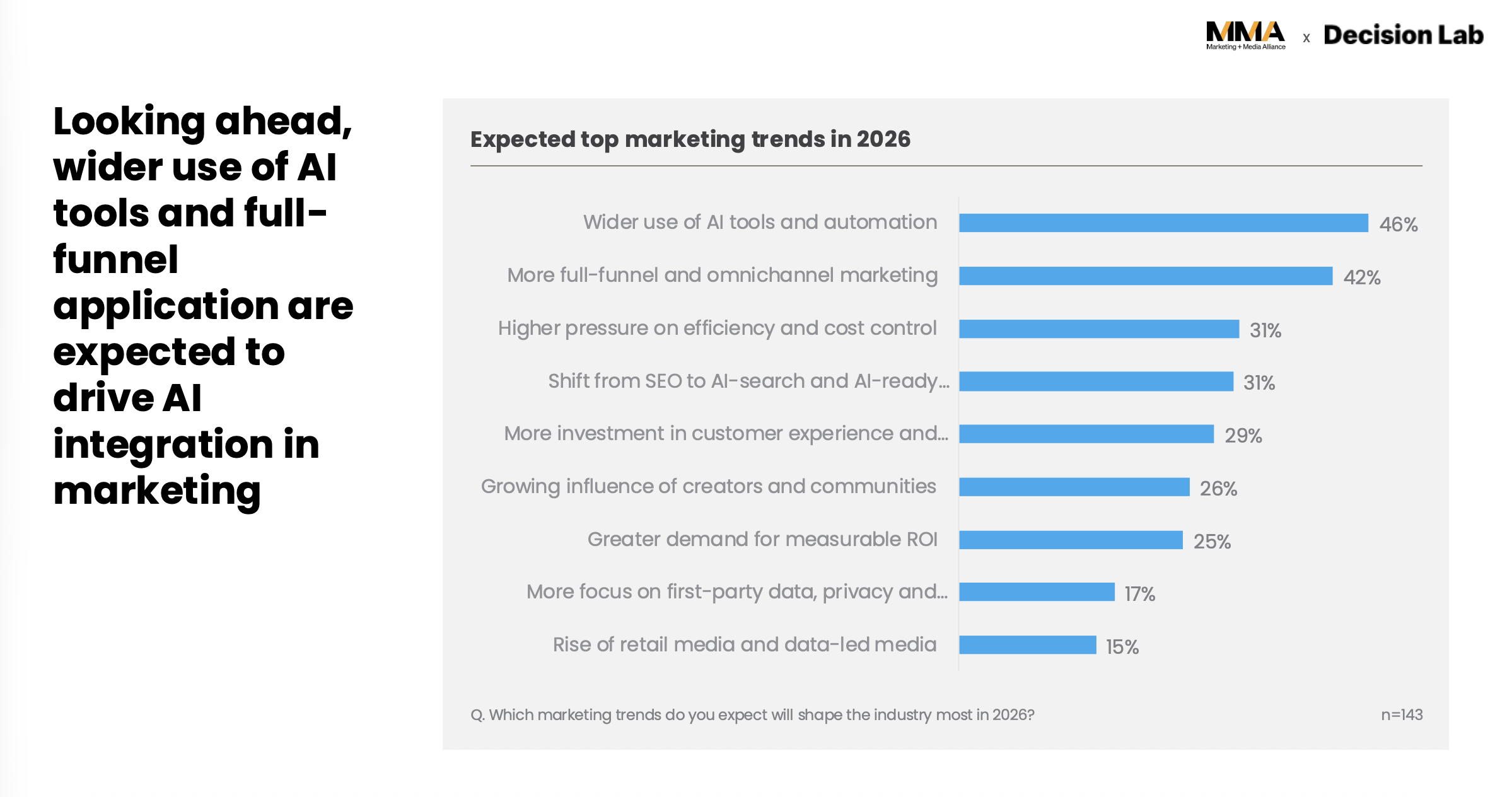
Automation, full-funnel coordination, and efficiency pressure describe the agentic use case without naming it. Full-funnel omnichannel work in particular is a coordination problem before it is a creative one, and coordination across channels and stages is what the current operating model handles worst.
The underlying business case is unchanged and firmly commercial: cost reduction (69%), customer experience (58%), driving innovation (58%), and revenue acceleration (38%). Cost reduction leading by eleven points matters here, because efficiency is the easiest agentic case to build and defend internally.
There is also a budget signal, and it favours the teams already ahead. Advanced adopters are the most likely to expect budget growth in 2026, with 18% anticipating a significant increase and 24% a moderate one. The teams best positioned to move first also have the most room to fund it. That is how leads compound, and it is why the window on this white space is measured in quarters rather than years.
The barrier is the same one holding back everything else
If the opportunity is this clear, why is deployment this low? The report is direct. The top challenge to scaling agentic AI is the talent and skills gap at 37%, far ahead of data quality (17%), ROI uncertainty (17%), budget (12%), regulation (10%), and infrastructure (7%).
The blocker is not procurement. Agentic platforms are available and, for most marketing budgets, affordable. What few teams have is people who can design an autonomous workflow, supervise it while it runs, and audit it afterwards. Those are new roles inside a marketing function, and they are not created by buying the software.
The report also documents how leading teams build that capability: training courses (68% vs 44% for early adopters), peer discussions (68% vs 48%), and workshops (66% vs 52%). Hands-on practice, not reading. Which means the honest timeline for an agentic capability starts with people, and the procurement decision is the easy part that comes later.
One caution belongs alongside the opportunity. Only 44% of advanced adopters have a formal AI risk strategy, and top concerns already include fabricated answers (51%) and biased responses (54%). Handing more autonomy to systems inside an organisation with no governance structure is how a capability advantage turns into an incident. The autonomy that makes agentic AI valuable is the same property that makes ungoverned deployment dangerous.
How to take the opening
- Pick one multi-step workflow, not a tool. Media allocation, journey orchestration, or measurement, where scaled AI use is currently lowest and the coordination cost is highest. Starting with a tool produces a pilot in search of a problem. Starting with a workflow produces a result you can defend.
- Staff it before you scale it. The 37% skills barrier is the binding constraint, and it closes through applied practice rather than procurement. Name who designs the workflow, who supervises it, and who audits the output, before the first run.
- Put the guardrails in first. Define escalation, review points, and accountability while the deployment is small enough to control. Governance written for one workflow is a page. Written after five are live, it is a retrofit.
From adoption to readiness
The through-line of the report is the move from AI adoption to AI readiness. Adoption tells you a team has started. Readiness tells you whether it can integrate AI across functions, build the skills to run it, and govern it well enough to trust the output.
Southeast Asia has finished the first part. Agentic AI is where the second part gets decided, and right now almost no one in the region has a head start. As Rohit puts it in closing the foreword:
The leadership task now is to move from experimentation to capability, from tool adoption to operating transformation, and from enthusiasm to accountable impact.
For once, the field is level enough that the task is achievable. That will not be true for long.
Explore the full picture
The full benchmark breaks down adoption maturity, use cases, challenges, risks, and the 2026 outlook across five Southeast Asian markets.
Download the full report:
State of AI in Marketing 2026: Southeast Asia
The State of AI in Marketing 2026: Southeast Asia is a thought leadership report from the Marketing + Media Alliance (MMA) and Decision Lab, based on a survey of 143 marketing professionals across Indonesia, Vietnam, the Philippines, Thailand, and Singapore, fielded January to April 2026.