The production problem is solved. Now comes the harder one: keeping your brand coherent when machines are making thousands of decisions about it every day.
For years, brand leaders have chased the same thing: more content, faster production, greater reach. AI delivered all of it. Thousands of variants. Instant adaptation. Campaigns localised across markets in hours. The creative bottleneck that once defined marketing operations is, for all intents and purposes, gone.
And yet something quieter is breaking.
When machines generate content at scale, brands don’t fail loudly. They don’t wake up one morning to find their identity unrecognisable. They drift. Incrementally. Invisibly. A tone that gets slightly more urgent. Messaging that leans a little more promotional. A creative expression that, variant by variant, moves away from what the brand actually stands for.
This is the creative challenge nobody is talking about enough. And for CMOs navigating AI-driven marketing in 2026, it may be the most consequential one.
The Problem Isn’t Volume. It’s Drift.
Structural drift is the gradual movement of a brand away from its intended positioning under the pressure of automation. It doesn’t announce itself. It accumulates quietly, in the space between what a brand means and what AI is optimising for.
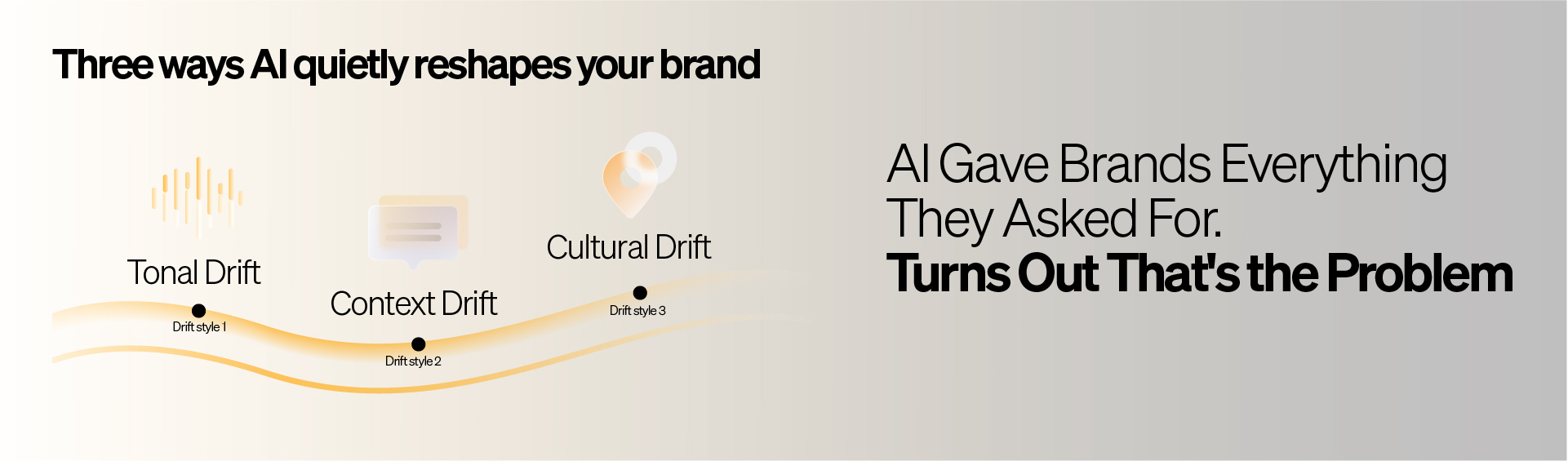
Three forms are becoming visible across organisations scaling AI-generated content:
Tonal drift. AI adapts language to maximise response. A brand built on restraint and nuance can find its voice becoming more direct, more promotional, more urgent over time — not because strategy changed, but because optimisation nudged tone incrementally.
Context drift. Platform environments shape emphasis. Retail and commerce contexts naturally prioritise price, promotion, and immediacy. As AI generates creative tailored to these environments, brand storytelling narrows. Rich narratives collapse into functional claims.
Cultural drift. Localisation at scale does more than translate. AI adapts language based on patterns that perform well in each market. A brand known for subtle, restrained messaging may find its variants becoming more benefit-led or promotion-focused in certain regions — not incorrectly, but meaningfully differently.
None of these shifts are dramatic. That is precisely the problem. Drift accumulates invisibly — variant by variant, optimisation by optimisation.
Most brands are measuring output. Few are measuring drift. And by the time the divergence is visible, the damage is done.
Creative Control Has Moved Upstream
The conventional response to brand consistency at scale is governance: reviews, approvals, brand guidelines. These tools were built for a world where creative output was manageable. In a world of continuous, machine-generated variation, they simply cannot keep pace.
Creative control in 2026 is less about reviewing individual executions and more about defining the parameters within which those executions are generated. The locus of control has shifted from outputs to inputs.
The question is no longer whether an individual execution reflects the brand. It’s whether the system generating it is designed to preserve it.
That reframes creative leadership entirely. The most important creative decisions a CMO makes today are not about campaigns. They are about architecture. What is fixed, regardless of context? What can flex without altering positioning? Which performance signals are allowed to influence messaging? Where does optimisation stop and brand intent take precedence?
When these parameters are clearly defined, automation strengthens coherence. When they are not, systems optimise for immediacy rather than meaning.
What Winning Looks Like: Strategic Encoding
Leading organisations are approaching AI-driven creativity not as a production engine but as a layered system. The most critical layer is what practitioners are beginning to call strategic encoding: the translation of brand intent into structured inputs that machines can interpret consistently.
This goes beyond visual guidelines or tone-of-voice documents. Strategic encoding includes:
- Clear narrative territories that define what the brand talks about — and what it doesn’t
- Emotional non-negotiables that govern how the brand makes people feel
- Defined brand vocabulary and guardrail lexicons — words and claims that must or must not appear
- Visual constants that cannot be optimised away regardless of performance signal
Strategic encoding transforms a brand from a campaign idea into a set of structured inputs machines can interpret consistently. It’s the difference between hoping AI gets your brand right and designing a system that makes it structurally difficult to get it wrong.
The Data Makes the Case
The evidence for structured creative systems is no longer theoretical. The MMA Consortium for AI Personalization (CAP) ran seven brand experiments using AI-driven personalisation built on disciplined creative frameworks. The results were significant.
Average performance lifts exceeded 100% versus traditional approaches. In some cases, lifts reached as high as +259% on defined KPIs including webpage visits, app installs, and form completions.
Critically, these gains did not come from producing more variants. They came from pre-defining narrative buffers, controlled variation sets, and optimisation boundaries before scaling AI-generated diversity.
That distinction matters enormously. The competitive advantage in AI-driven marketing is not generative speed. It is the clarity of the framework that governs what gets generated.
Brands that invest in defining those frameworks before scaling will outperform those that scale first and define later. The data is unambiguous on this point.
The New Creative Mandate for CMOs
The role of creative leadership is changing. In an environment where machines generate variation automatically, advantage is less about output and more about definition.
CMOs who will lead in this environment are asking different questions:
— Not just ‘what should we create?’ but ‘what should our system never create?’
— Not just ‘how do we scale content?’ but ‘how do we encode meaning before we scale?’
— Not just ‘are our executions on-brand?’ but ‘is our architecture designed to keep them that way?’
This is a fundamentally different kind of creative leadership. It requires precision in how brand intent is articulated, rigour in how optimisation boundaries are set, and organisational alignment across marketing, data, legal, and commerce teams.
It also requires a willingness to treat creative systems as infrastructure — not as production tools to be deployed, but as brand assets to be governed.
Coherence Is the New Competitive Discipline
The brands that will define the next decade of marketing are not the ones generating the most content. They are the ones maintaining the most coherent brands while generating at scale.
In a world of infinite variants, coherence is not a creative virtue. It is a business one. It protects pricing power. It sustains differentiation. It builds the kind of brand recognition that compounds over time rather than erodes under the pressure of optimisation.
AI gave brands everything they asked for. The organisations that will benefit most from it are the ones that now ask something harder of themselves: not how to generate more, but how clearly they can define what they stand for before the machine does it for them.
The production problem is solved. The coherence problem is just beginning.
Want to explore more on this topic?
We publish ongoing thinking at the intersection of brand strategy and AI-driven marketing. If this piece raised questions relevant to your organisation, we’d encourage you to explore more of our work below.