Impressions, clicks, and viewability are ceasing to be the go-to indicators for guiding digital media or awareness campaign strategies. Traditional metrics reveal nothing about actual consumer contact. The mechanics of ad delivery are taking a backseat to the quality of attention dedicated to viewing it. The problem is that attention is incredibly difficult to measure objectively. Standards are virtually non-existent, and the gap between platform metrics and actual human behavior continues to widen
Unmeasured Attention
What we are witnessing in the industry today is not a measurement crisis, but the natural evolution of the digital advertising market. Today, the winners are those who can prove that a contact with the target audience did not merely occur, but was actually seen, understood, memorized, and delivered the intended impact.
Even though many platforms have introduced proprietary metrics to evaluate attention, brands have run into a systemic problem: the lack of unified benchmarks makes comparing formats difficult, and sometimes outright absurd. A metric can accurately show which format performed better within a specific campaign, but that doesn’t mean it performs well relative to the market as a whole.
The second issue is trust. The attention-measurement trend caught on quickly, spawning a massive influx of offerings. However, without independent verification and assessment, they remain “black boxes.”
The third challenge runs even deeper: while there are no established rules of the game yet, betting on a single “silver-bullet” metric is almost guaranteed to derail a brand’s focus. Brands need to rely on a mix of sources: platform analytics, third-party measurements, and their own creative research.
When the Measurements are Taken
Currently, the only way to objectively evaluate attention is through measurement by third-party, independent verifiers.
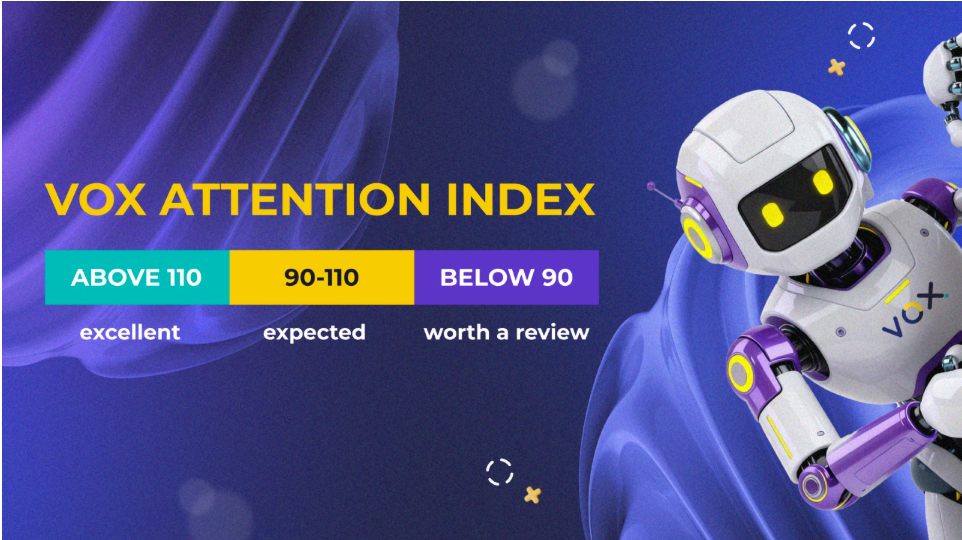
In market practice, this is achieved using integrated attention indicators that aggregate dozens of user behavior signals, such as Weborama’s Attention Score. This metric assesses contact quality through scores of signals – anging from viewability and tab activity to cursor movements, page scrolling, and video interactions. The final score on a scale of 1 to 100 reflects the depth of attention retention.
Crucially, the Attention Score is built upon an MRC-accredited (Media Rating Council) methodology, guaranteeing its reliability and comparability with global standards. The Media Rating Council is an international non-profit association responsible for developing industry standards for media measurement and directly auditing verifiers.
According to Weborama data, the average attention index score for standard desktop and mobile banner ads (without device breakdown) sits at 17.08 points. For video ads, this figure reaches 30.72 points. Based on recent ad campaigns, formats embedded directly within editorial images on popular websites (in-image advertising) demonstrate a comparable level of attention – around 29 points. This brings their visibility remarkably close to video advertising and significantly outperforms classic banners.
However, even such an objective metric only reveals part of the picture. It records the interaction but fails to answer what emotions the creative evokes and why a user pauses exactly there.
Neuromarketing Research: Clear Insights into Effectiveness Depth
The answer to what exactly a person notices, what brings them joy, and what causes irritation begins where classic indicators end. To be fair, time-to-click, cursor hovering, closing a banner, scrolling decelerations, attention rates, and full animation completions display the pure mechanics of interaction quite objectively.
Over the past two years, we have conducted several offline neuromarketing studies, and we’ve observed how real visual behavior is shifting. Tracking eye movements, analyzing facial expressions and emotions, and conducting post-surveys allow us to clearly evaluate not just the duration of a contact in seconds, but its quality.
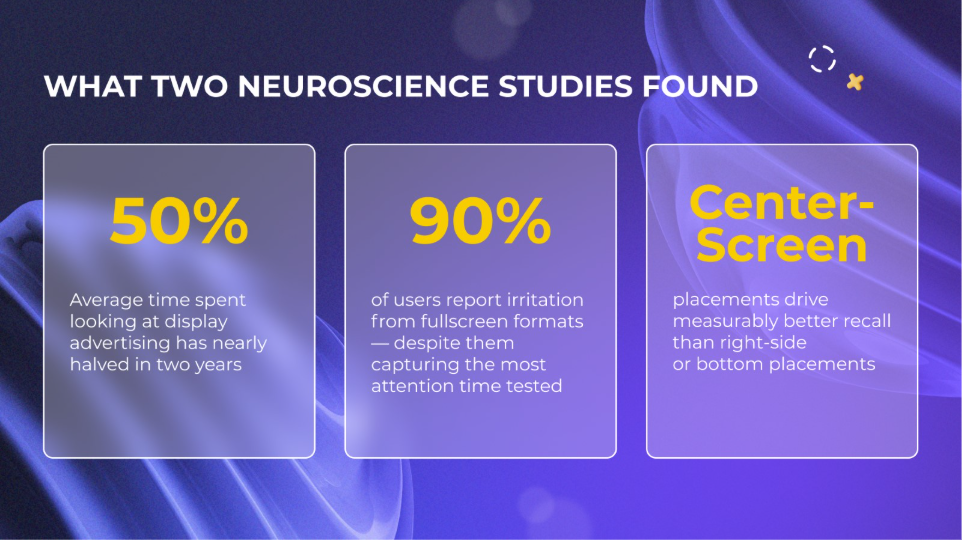
The average time of ad contact has dropped nearly by half, and surprising people has become significantly harder. Of all the tested formats, only creatives embedded within an image (in-image ads) featuring “wow-effects” (non-standard, eye-catching elements, such as fruit flying out of the banner boundaries for a grocery delivery service) consistently triggered emotions of joy and increased the depth of perception.
In contrast, full-screen formats that overlay all content capture the maximum number of seconds, but trigger irritation in roughly 90% of users. This type of attention is technically high, but it does not build brand equity and might even work against it.
Placements in the center of the screen, on the other hand, are remembered exponentially better. Even a weak creative wins if it is located in the focus zone, whereas banners on the right or bottom of the screen leave almost no trace in memory, no matter how flawlessly they are designed.
A Bridge Between Offline and Online
Our practical experience with international research centers shows that in an online environment, real visual attention cannot be calculated or measured directly. It can only be captured under laboratory conditions: test participants view web pages on computers equipped with specialized hardware that tracks user reactions. From there, the principle of extrapolation takes over, assuming that similar formats will perform in a similar manner.
This is exactly how online campaign effectiveness checks are structured: first, a sample of people is analyzed to measure the perception of specific ad formats, and then a mathematical model is built to scale and measure the results in the digital space.
This serves as a bridge between real human reactions and online metrics. For the market, the logical next step would be launching large-scale industry studies to establish baseline attention benchmarks.
Why a Technological “Wow” Has Become Mandatory
In recent years, we have journeyed from native placements powered by computer vision to AI-driven formats. These formats don’t just stand out – they retain users through personalized interaction logic.
For instance, leveraging AI capabilities, ad banners can integrate the product from a catalog that is most relevant to that specific individual into the creative. Other formats are evolving to include interactive scenarios inside the ad unit itself: built-in chatbots allow users to ask clarifying questions or get basic product info at the exact moment of ad contact. This isn’t just a demonstration; it is a live dialogue with users in real time, enhanced by the ability to identify their needs.
The development of algorithms capable of recognizing any content on web pages also plays a substantial role. These algorithms can identify objects, visual characteristics, and age indicators, linking them to the most fitting advertiser offers.
The technological “Wow” factor has ceased to be an anomaly. Today, it is a standard tool that allows brands to increase both the time and quality of a contact. The old principle of placing a massive banner on the right side of the screen no longer works. To be noticed, you must manage and surprise through technology, not just through design.
Advertising That Works Today
Companies are gradually transitioning to a comprehensive approach, adjusting to the latest shifts in the advertising market. First, a conscious approach to ad placement has become absolutely critical. Center-screen positions and native formats have proven their memorability, meaning they give brands a distinct competitive edge.
Second, a neuromarketing research culture is taking shape. While this has long been the norm for TV, it is only now beginning to become a standard for digital. Testing the key message, emotions, and design prior to launch saves budgets, mitigates risks, and helps deliver more realistic forecasts. A poor creative cannot be rescued by even the most “visible” placement.
And, of course, it is vital to combine different sources of truth: cross-referencing platform data with third-party verifiers and validating hypotheses through offline research. This is the ultimate safeguard against blindly trusting metrics that fail to explain the context.