New benchmark from Marketing + Media Alliance (MMA) and Decision Lab maps how deeply marketing teams across the region have integrated AI, and where the real gaps remain.
For years, the question in Southeast Asian marketing was whether to adopt AI, and that question is now settled. The Marketing + Media Alliance (MMA) and Decision Lab have released The State of AI in Marketing 2026: Southeast Asia, the region’s most detailed read on how far AI has moved from experiment to operating core, and the answer is unambiguous: adoption is no longer the edge, it is the starting line.
What follows is a walkthrough of what the data actually says, moving from the headline numbers down to the gaps that will separate the leaders from everyone else in 2026.
Start with the headline: adoption is mainstream
Two numbers reset the conversation.
- 57% of SEA marketers are already at an advanced AI maturity stage (Stage 3 and 4), building AI into how they work rather than testing it in isolated pilots.
- 80% now include AI in their marketing plans at a moderate level or higher. AI has crossed from a side project into the core of how campaigns are planned, built, and measured.
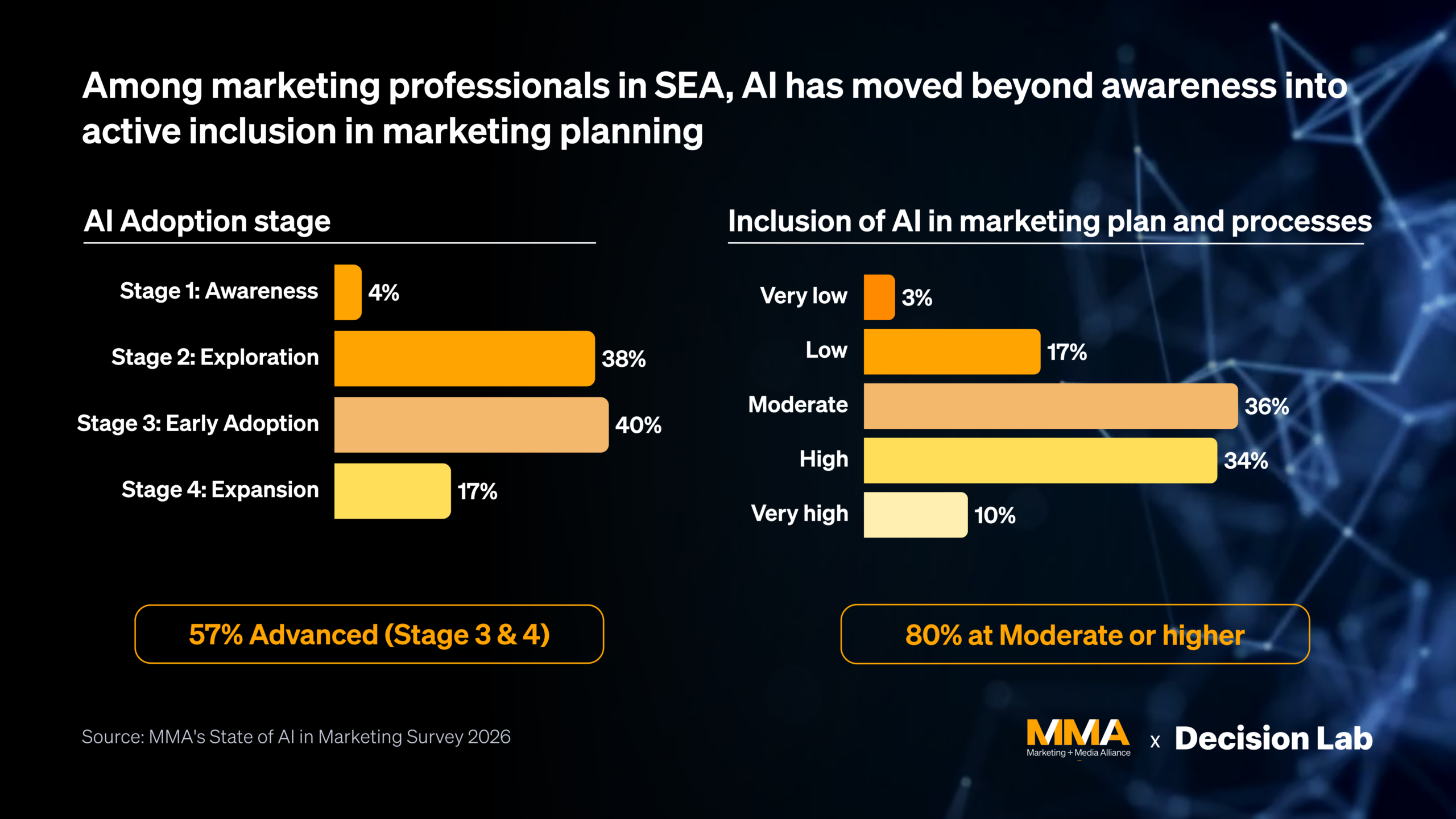
Read together, these figures reframe the debate, because AI is no longer something marketing teams try, it is something they plan around. And the region is not playing catch-up either: benchmarked against the US and global averages, SEA is ahead, with nearly half of organisations already scaling or fully scaling AI.
But look closer: the maturity is shallow
Mainstream adoption does not mean deep integration, and when you break the stages apart, only 17% have reached the top Expansion stage. Even among the advanced majority, most have not yet fully embedded AI, so while most organisations have started, few have truly scaled.
That is the tension running through the entire report. The headline says “everyone is in,” yet the detail says “almost no one is finished,” and the distance between those two statements is where the real story lives.
The real gap is integration, not access
That distance comes down to one finding that should change how teams think about their AI investment: the difference between advanced and early adopters is not who owns the most tools. Advanced adopters out-adopt early adopters across every single tool category, but the gap is really in how consistently they apply AI across functions.
The spreads are wide and telling:
- Creative and content AI: 80% of advanced adopters vs 49% of early adopters.
- Generative AI: 74% vs 57%.
- Data intelligence and prediction: 46% vs 25%.
And when you look at where AI is genuinely scaled, the same pattern holds, because advanced teams are running AI at scale in content and creative production (54% vs 25%), customer insights and analytics (41% vs 21%), and media allocation (33% vs 10%). Access to AI is now near-universal, so integration, not ownership, is what separates the field.
The next frontier is wide open
If integration is the gap today, the next one is already visible, and it is agentic AI. Even among advanced adopters, only 17% are at full-scale agentic implementation, while more than a quarter are not yet aware of it or are only just exploring, and overall agentic adoption sits at just 32% for advanced teams and 15% for early ones.
In other words, for a region that has moved fast on general AI, this is the next race, and almost no one has a head start yet.
What is holding teams back is people, not budget
If so few have reached that frontier, the natural question is what is stopping them, and the answer is not what many leadership teams assume. The number one bottleneck is the talent and skills gap, cited by 37%, far ahead of data quality (17%), ROI uncertainty (17%), budget (12%), and regulation (10%), and the point is reinforced elsewhere, with 78% of advanced adopters naming “requires skill and training” as their top AI challenge.
The report is equally direct about how leaders actually close that gap, because they learn by doing rather than by reading. Advanced adopters over-index on active learning, from training courses (68% vs 44%) to peer discussions (68% vs 48%) and workshops (66% vs 52%), whereas early adopters lean on passive industry reports, so hands-on practice is what separates the two.
Risk awareness is high. Governance is missing.
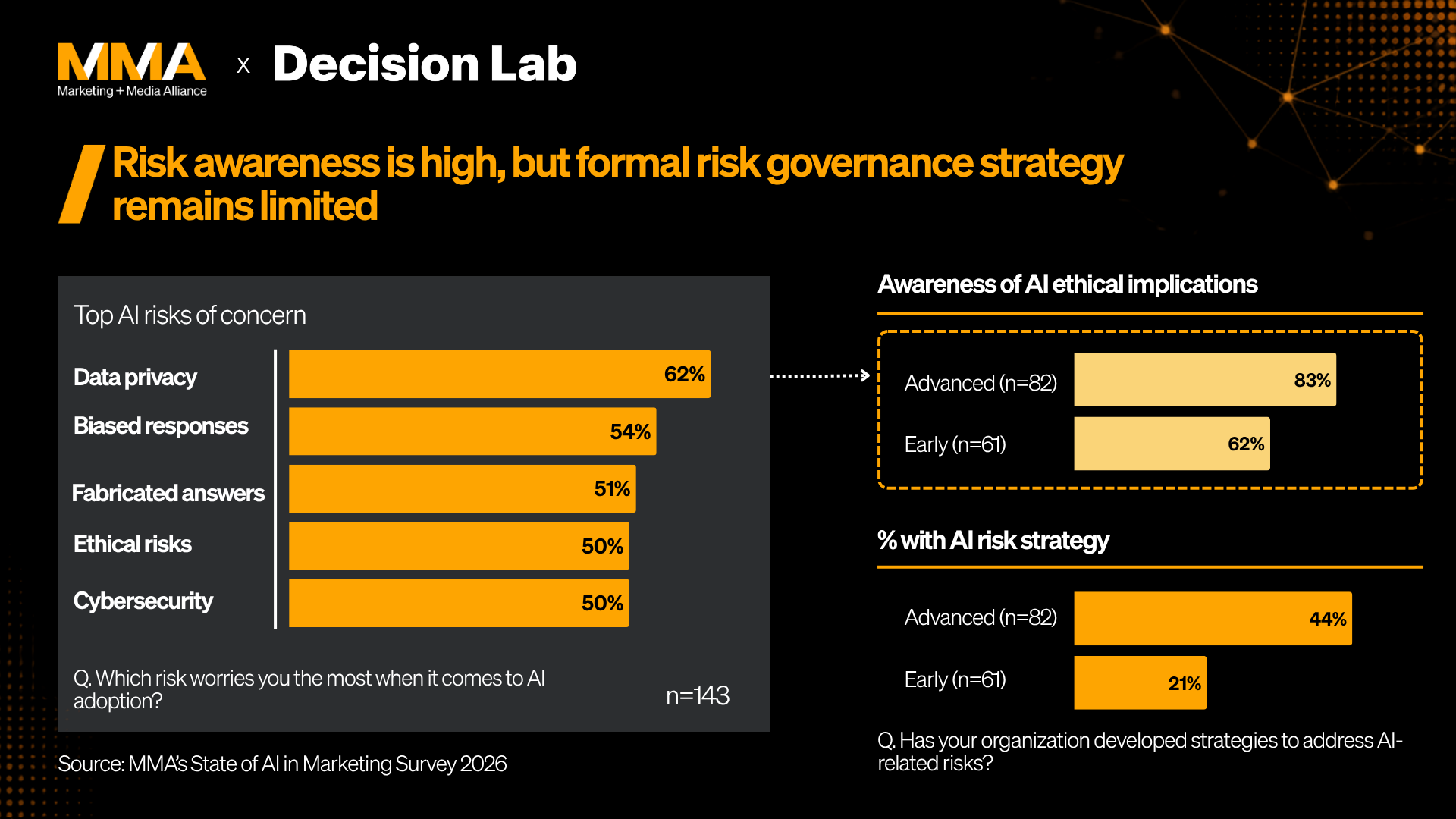
Building capability solves only half the problem, however, because as usage deepens the risks rise with it. Marketers in the region are clearly alert to those risks, and the top concerns are data privacy (62%), biased responses (54%), fabricated answers (51%), and ethical risk (50%), yet awareness has not translated into structure: only 44% of advanced adopters, and just 21% of early ones, have a formal AI risk strategy in place.
That gap matters, because awareness without governance is an advantage you cannot defend, and as AI scales across more decisions, responsible AI stops being a compliance footnote and becomes a competitive requirement.
From AI adoption to AI readiness
Taken together, these threads point to a single idea at the centre of the report, and it is the frame every marketing leader should take from it: the move from AI adoption to AI readiness.
Adoption tells you a team has started, whereas readiness tells you whether it can scale AI across functions, build the skills to run it, and govern it responsibly enough to trust the output. The data shows Southeast Asia has done the first part, so the leaders of 2026 will be the ones who build the second.
As Rohit Dadwal, CEO and BOD of MMA APAC and Global Head of SMARTIES, puts it:
The question is no longer whether AI belongs in marketing. It is how deeply, how responsibly, and how fast organisations can convert it into measurable advantage.
The report’s own outlook points the same way, since marketers expect wider automation (46%), more full-funnel and omnichannel work (42%), and a shift from SEO toward AI-ready content (31%) to shape the year ahead, and advanced adopters are the most likely to expect budget increases. As a result, the teams already integrating AI are the ones positioned to compound their lead.
Explore the full picture
The numbers here are the opening argument, not the whole case. The full benchmark breaks down adoption maturity, use cases, challenges, risks, and the 2026 outlook across five markets, giving marketing leaders a clear read on where their own teams stand.
Download the full report to explore all the findings across Southeast Asia: State of AI in Marketing 2026: Southeast Asia
The State of AI in Marketing 2026: Southeast Asia is a thought leadership report from the Marketing + Media Alliance (MMA) and Decision Lab, based on a survey of marketing professionals across Indonesia, Vietnam, the Philippines, Thailand, and Singapore.