The returns your dashboard can’t see are the ones that compound.
Let me give you a number that should stop every CMO in their tracks.
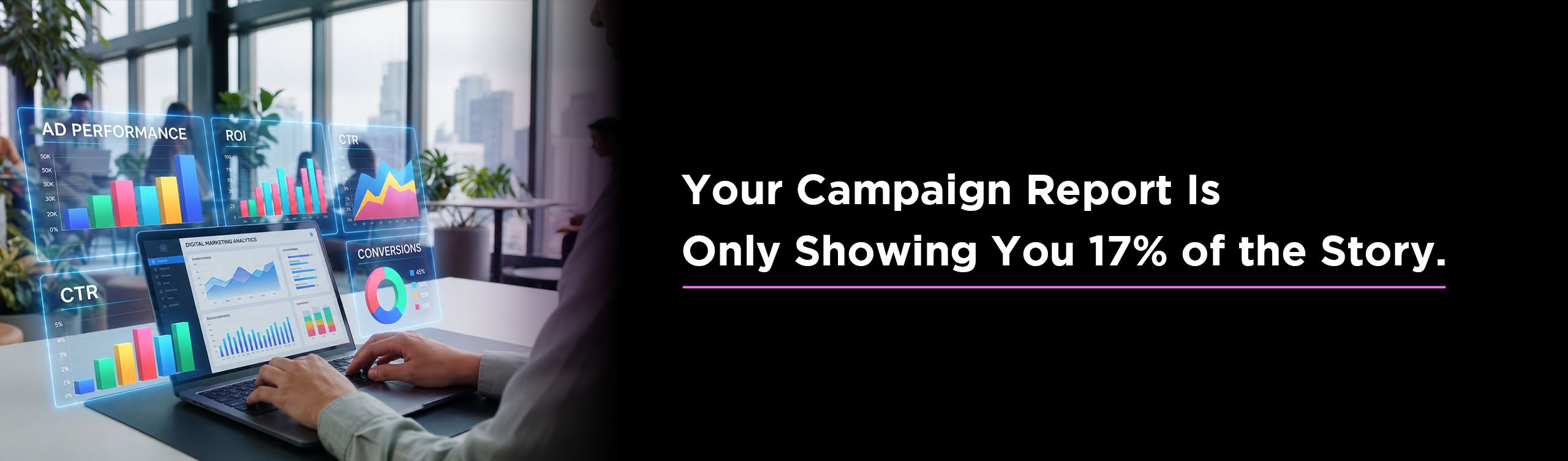
Kroger ran a brand campaign. Standard attribution tools measured the impact. What they captured was 17% of the actual sales effect. The other 83% was real, measurable, and happening — just outside the window most measurement systems are built to see.
This isn’t a Kroger problem. It’s a marketing industry problem. And MMA Global’s Brand as Performance research makes it impossible to ignore any longer.
We have built the most sophisticated performance measurement infrastructure in the history of marketing. And in doing so, we have systematically undercounted the value of what marketing actually produces.
1. The Dashboard Is Not Lying. It’s Just Looking in the Wrong Direction.
Attribution models were designed for a specific job: tell us what happened, quickly, so we can optimise. They do that job well. Click-through rates, immediate conversion, short-term ROAS — these are legitimate signals and the infrastructure built around them has made marketing more accountable.
But accountability for what happened last week is not the same as understanding what marketing is worth.
MMA Global’s Brand as Performance study tracked three major brands — Kroger, Ally Bank, and Campbell’s — connecting individual consumer-level brand sentiment data to actual purchase behaviour over nine to ten months. The results were consistent and striking. Conventional attribution undervalued Kroger’s marketing contribution by 83%. For Ally Bank, the gap was 44%. For Campbell’s, 60%.
The returns weren’t absent. They were downstream. Building. Compounding. Invisible to a dashboard with a 30-day window.
This is the measurement blind spot. And in APAC — where CMOs are under growing pressure from CFOs to justify every dollar — mistaking an incomplete picture for the full one is a strategic liability.
2. Favorability Is Not a Soft Metric. It Is a Leading Revenue Indicator.
Here is what the BaP research found that I think reshapes the entire brand vs performance debate.
Favorable consumers — those with higher brand affinity created by brand marketing — converted at between 2.9 and 4.7 times the rate of non-favorable consumers. Not marginally better. Structurally different in their commercial behaviour.
And the long-term conversion lift was between 1.8 and 6 times the short-term effect. For Kroger specifically, seven months after a three-month brand campaign ended, the long-term sales impact was 6 times the short-term figure — and 70% of that came from the favorable consumers the campaign created.
Brand marketing built the audience. Performance marketing converted it. Both were essential. Neither was sufficient alone.
For Ally Bank, maintaining a brand-forward strategy over two years was projected to deliver 16% more customers and 29% more accounts than an equivalent short-term performance approach. The compounding effect of brand investment doesn’t show up in your weekly report. It shows up in your market share two years from now.
This is why I have consistently argued at MMA Global events across APAC that the brand vs performance binary is a false choice — and a dangerous one. It is not either/or. It is sequence, proportion, and patience.
3. If You Can’t Measure It, You Will Cut It. And That Is the Trap.
The most consequential risk this data exposes is not that brands are under-investing in brand marketing. It is that they are making investment decisions based on an incomplete ledger.
When attribution closes at 30 days, long-duration brand effects become invisible — not because they don’t exist, but because the measurement infrastructure was not built to track them. And when leadership can’t see the return, the budget gets reallocated to what the dashboard rewards: short-term performance tactics with clean, fast metrics.
The cycle is self-reinforcing. Cut brand. Performance numbers hold short term. Long-term favorability erodes. Conversion rates slowly decline. By the time the damage is visible, the connection to the original decision has been lost.
In markets like Vietnam, Indonesia, and India — where brand trust is a primary driver of purchase in high-consideration categories — this erosion is particularly costly. Consumers in these markets are not transacting with brands. They are transacting with relationships. And relationships are not built in a 30-day attribution window.
The solution is not to abandon short-term measurement. It is to build measurement systems that connect brand sentiment to long-term purchase behaviour — the way the BaP methodology does — and present the full commercial arc to the CFO, not just the last week’s slice.
See the Full Picture. Own the Full Return.
Marketing is producing more value than most organisations are measuring. That is not a comforting thought — it is an urgent one. Because if you cannot see it, you cannot defend it. And if you cannot defend it, you will lose it.
The brands that win over the next five years in APAC will be the ones that built measurement systems as rigorous as their execution systems — and used that evidence to hold the line on brand investment when the short-term pressure came.
The dashboard tells you what happened last week. MMA’s Brand as Performance research asks the harder question: what is this week’s campaign still producing six months from now?
That is the question CMOs need to be asking. And answering.
Learn more about MMA’s Brand as Performance program at mmaglobal.com