Influencer marketing across APAC is moving beyond its original role as a reach-driven channel.
According to the State of Influence APAC 2026, which analyzes nearly 7,000 campaigns and over 1.1 million creators across 10 markets, the channel is increasingly being used to support business outcomes, not just visibility.
A more concentrated platform structure in Vietnam than the rest of APAC
Across APAC, platform usage varies significantly by market. Instagram remains the leading platform in markets such as Singapore (70.7%), Taiwan (57.7%), and Japan (56.4%). In parallel, platforms like Xiaohongshu are gaining share in markets such as Hong Kong and Malaysia.
Vietnam, however, shows a very different distribution. TikTok accounts for 62.9% of influencer marketing activity, followed by Facebook at 28.6%, while Instagram represents only 2.9%.
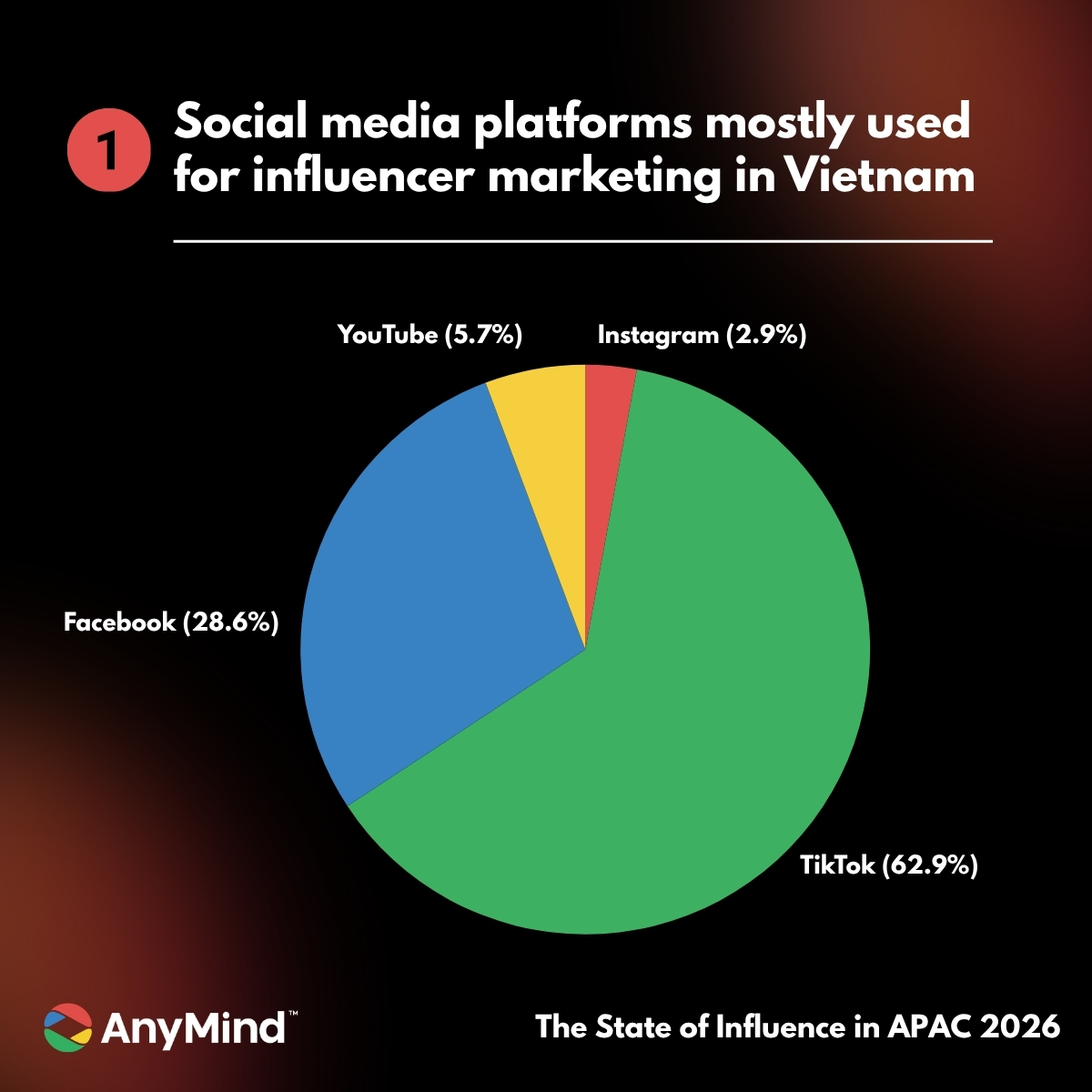
This makes Vietnam one of the most concentrated markets in the region, with over 90% of activity happening across two platforms. Compared to more fragmented markets, this creates a more defined environment for campaign execution.
Stronger Engagement from Nano Creators in Vietnam Compared to Regional Benchmarks
The report shows a clear shift across APAC toward nano and micro creators, but the level of effectiveness differs by market.
In Vietnam, nano creators deliver notably higher engagement rates than in neighboring countries. On TikTok, nano creators reach a median engagement rate of 16.18%, while on Facebook the figure is 9.24%.
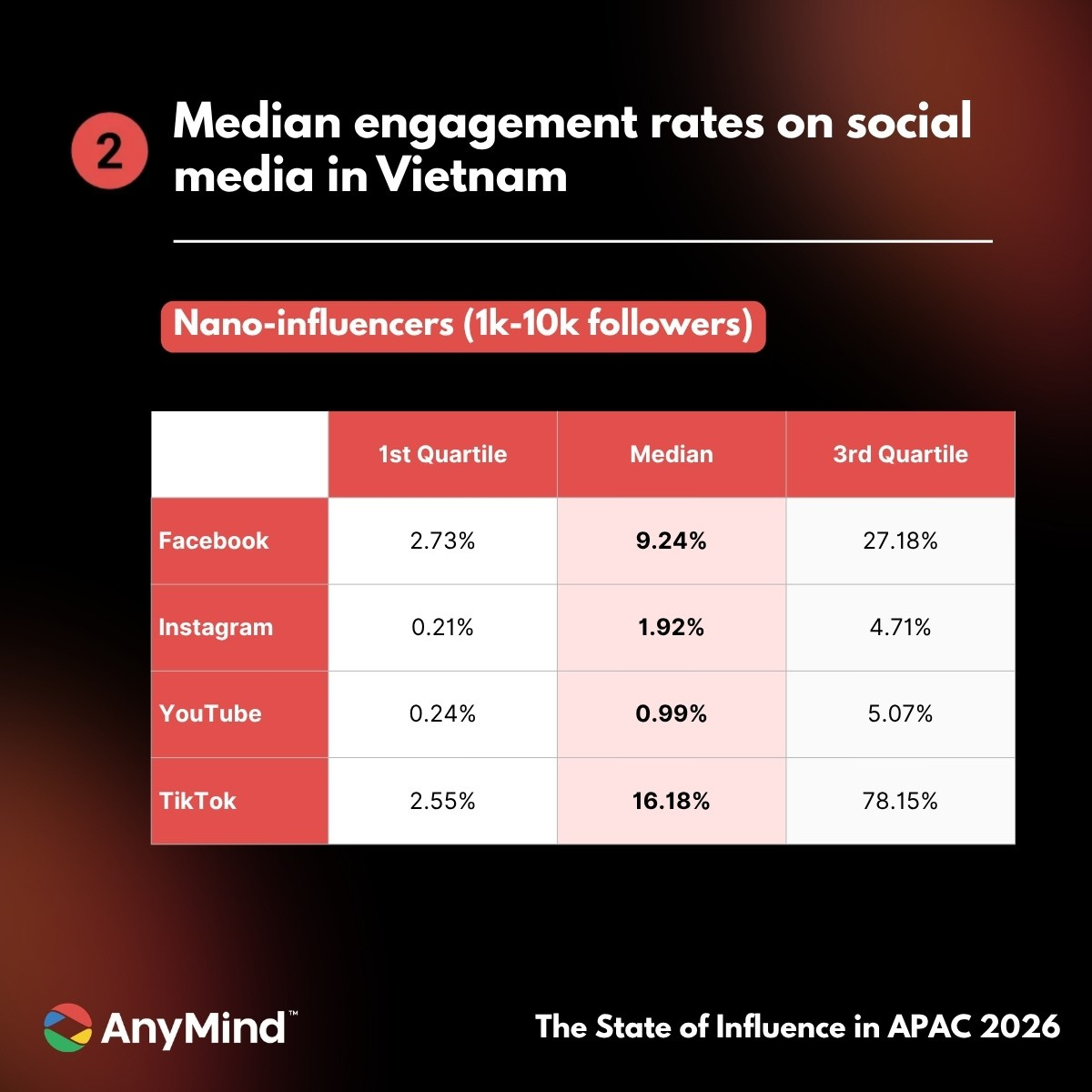
In comparison, nano creator engagement in markets such as Indonesia (0.82%) and the Philippines (1.16%) is significantly lower.
This gap is not simply a function of platform or format. It reflects a broader behavioral pattern, where influence in Vietnam is often built through closer, more frequent interactions.
Nano creators typically operate within smaller, more connected communities, where conversations are more active and content feels more experience-driven. As a result, recommendations tend to be perceived as more relatable and actionable, contributing to consistently higher engagement rates across this segment.
Category Investment Is Highly Concentrated in Key Sectors
Across APAC, influencer marketing spend is concentrated in categories such as Fashion & Beauty, Food & Beverage, and Lifestyle. Vietnam follows a similar pattern, but with a higher level of concentration.
Fashion & Beauty accounts for 47.2% of influencer marketing spend, followed by Food & Beverage at 29.1%. In addition, Family & Education represents nearly 20%.
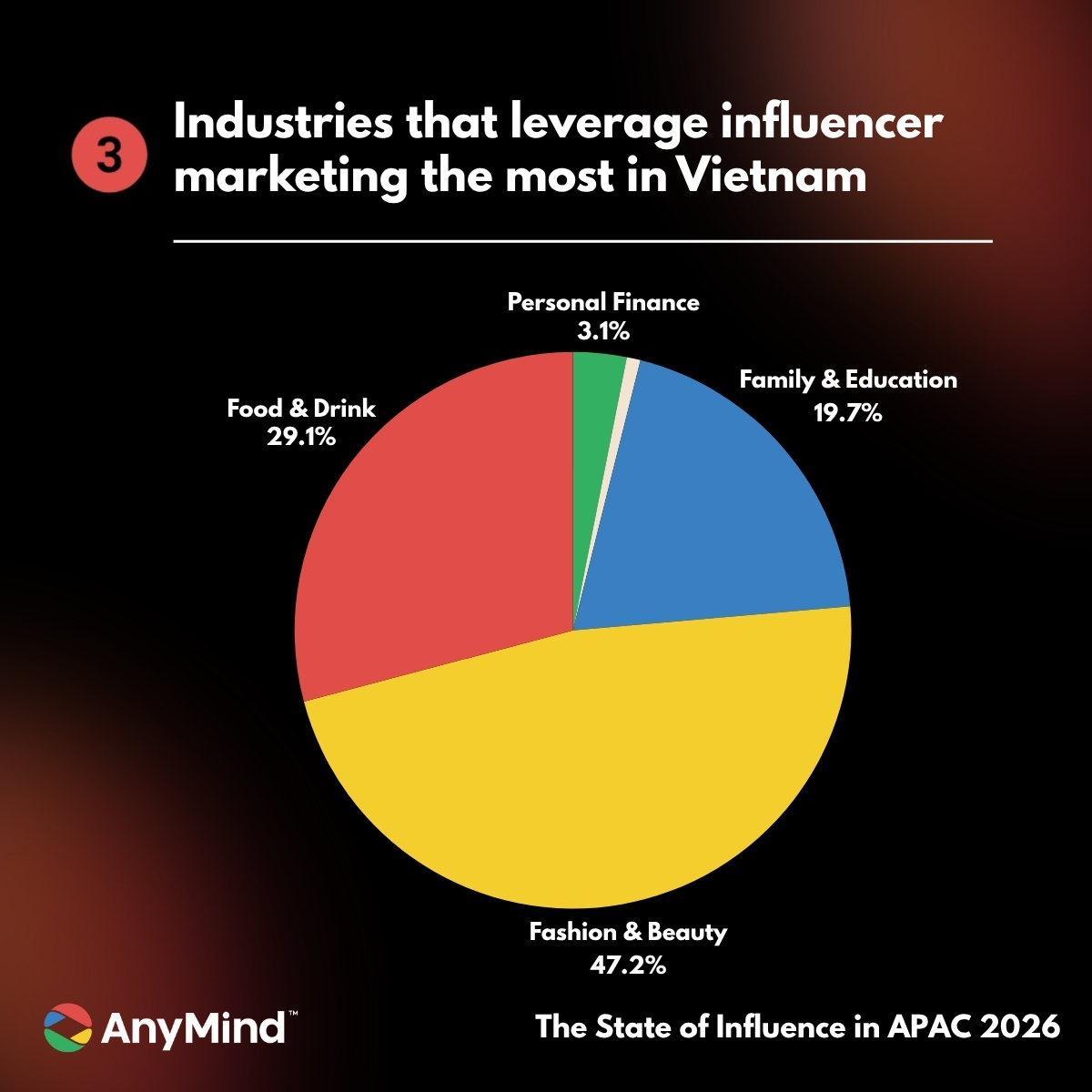
This distribution indicates that influencer marketing in Vietnam is heavily focused on categories where consumer decisions are frequent or require more consideration, aligning closely with areas of active consumer demand.
Full-funnel influencer marketing: The Cetaphil Case Study
A strong example is Cetaphil’s “3-Layer Moisture Coat” campaign in Vietnam.
Translating dermatological science into “3 layers of moisture”, the campaign made product benefits easier to understand and apply in everyday routines.
More than 100 creators and 30 online communities were activated, distributing content across multiple touchpoints instead of relying on a single burst.
Content combined creator-led storytelling alongside healthcare professionals, helping to ground product messaging in both real-life usage and dermatological understanding.
The campaign then extended into commerce through livestream and brand collaborations, connecting content more directly to purchase moments.
The impact was significant, contributing to a 159% year-over-year sales uplift, while also earning industry recognition at MMA SMARTIES 2025.
Conclusion
What both the data and case studies make clear is that influencer marketing can no longer be approached as a series of one-off campaigns.
In an era where decisions are shaped over time, and where trust requires reinforcement across multiple touchpoints, isolated activations are unlikely to deliver sustained impact. Instead, brands need to think in systems. This means building networks of creators, maintaining a consistent presence across platforms, and designing content that aligns with the full decision journey rather than just the awareness stage.
Influencer marketing, in this sense, becomes less about execution and more about architecture. It is a continuous layer of influence that sits within the broader consumer ecosystem.
Download our latest State of Influence in APAC 2026 report to uncover the latest trends shaping influencer marketing across APAC and get practical strategies you can apply today: https://anymindgroup.com/vi/report/im-report-2026/