A Vietnam & Southeast Asia Marketing Trends Perspective
Vietnam’s digital economy is expanding at one of the fastest rates in Southeast Asia. According to eMarketer and local industry trackers, the top five e-commerce platforms in Vietnam — Shopee, TikTok Shop, Lazada, Tiki, Sendo — generated US $12.6 billion GMV in 2024, a ~37% YoY increase from 2023. Projections indicate that GMV will reach US $15.4 billion by 2025, reinforcing Vietnam’s role as one of the region’s most dynamic digital commerce markets.
On the consumer side, Vietnam now has ~72.7 million internet users (~73.3% penetration in 2024). Digital shoppers spent an estimated US $16 billion online in 2024, driven by social commerce adoption, livestream retail, and a strong mobile-first culture.
Vietnam is evolving into a digital-first, ecommerce-powered consumer market — where discovery, attention, and conversion increasingly occur within closed-loop ecosystems. As a result, the marketing funnel has fundamentally changed. It is no longer linear. It is interconnected, always-on, and commerce-enabled.
The question for brands is no longer whether to adopt a full-funnel strategy — but how to operationalize one in an environment where platforms, content, creators, and commerce now overlap.
This report outlines five macro trends reshaping the new full-funnel growth model — with specific implications for Vietnam and Southeast Asia.
- The Funnel Has Become a Loop
Vietnamese consumers increasingly move through the entire customer journey — discovery, evaluation, purchase — without ever leaving the platform. TikTok Shop, Shopee Live, and Lazada Live are now content platforms, entertainment hubs, and checkout engines in one place. Especially, TikTok’s business model — content → engagement → livestream → in-app checkout — collapses the traditional funnel into a single continuous loop.
Global evidence reinforces this structural change. A 2024 study by GlobalData x TikTok Shop found that 83% of shoppers discovered a new product on TikTok Shop, and 70% discovered a new brand through TikTok Shop content.
Although Vietnamese platform-level performance data is not publicly disclosed, multiple local analyst reports highlight that TikTok Shop was one of the largest contributors to Vietnam’s e-commerce GMV growth in 2024.
Why it matters
Content + commerce = a compressed, always-on purchase loop. Brands must design content that can both educate and convert instantly — because discovery and purchase now occur in the same session.
- Brand and Performance Are Merging
Dynamic Creative Optimization (DCO) is reshaping both creative production and media effectiveness. Platforms can now read performance at the asset level and tailor creative to user context in real time.
For example, Innity Advertising Network reports that 40–50% performance improvement when creative variations match audience context, and shoppable ads that integrate 3D product views, multi-angle catalogs, and automated SKU-level personalization — capable of scaling to thousands of SKUs with minimal manual effort.
 Caption: Innity shoppable ads push e-commerce products in catalog ad, promoting brand image beyond commerce platfrom and bring shoppers to check out page upon a click.
In creator media, Innity applies the 3R framework — Reach, Relevance, Resonance — showing that performance depends on both audience targeting and creative engagement.
Why it matters
Today, “brand” and “performance” are converging into a single creative system:
- emotional resonance (brand)
- measurable sales signals (performance)
- modular content variations tailored to audience signals
- Data Signals Are Creating Many Micro-Funnels
Rather than pushing every user through a single funnel, advanced advertisers now activate dozens of micro-funnels based on:
- search intent
- viewing behavior
- cart actions
- engagement depth
- purchase recency
- product affinity
Platforms process billions of signals, reallocating media in real time to maximize efficiency.
Example: Amazon DSP — The Intent Engine
Amazon uses behavioral triggers to assign users to micro-funnels:
| Signal | Micro-Funnel Action |
| Product viewed | Show product education video |
| Added to cart | Trigger incentive to purchase |
| Frequent buyer | Recommend bundle or upgrade |
| Category browser | Spark top-funnel discovery |
Beyond walled gardens such as Amazon, TikTok, Facebook, and YouTube, open-web platforms also use Data Management Platforms (DMPs) to unify signals across publishers and build granular audience journeys.
Why it matters
Vietnam’s shoppers are high intent and high frequency, making micro-funnels essential.
Brands should map multiple journeys: price-sensitive shoppers, new-to-brand audiences, loyal customers, heavy browsers, and reactivation segments.
This shift increases efficiency and relevance across the entire purchase cycle.
- Commerce Is Now the Center of the Entire Funnel
E-commerce is no longer the end of the journey — it is the new branding environment.
Product Detail Pages (PDPs) have evolved from simple checkout pages to immersive brand experiences.
Example: Dyson — Engineering the Brand-First PDP
Dyson redesigned its PDP strategy to shorten decision cycles and enhance brand perception — especially for high-consideration appliances. The PDPs integrate premium storytelling videos, technical breakdowns, scientific performance claims, UGC and real-user testing, and real-time chat and support.
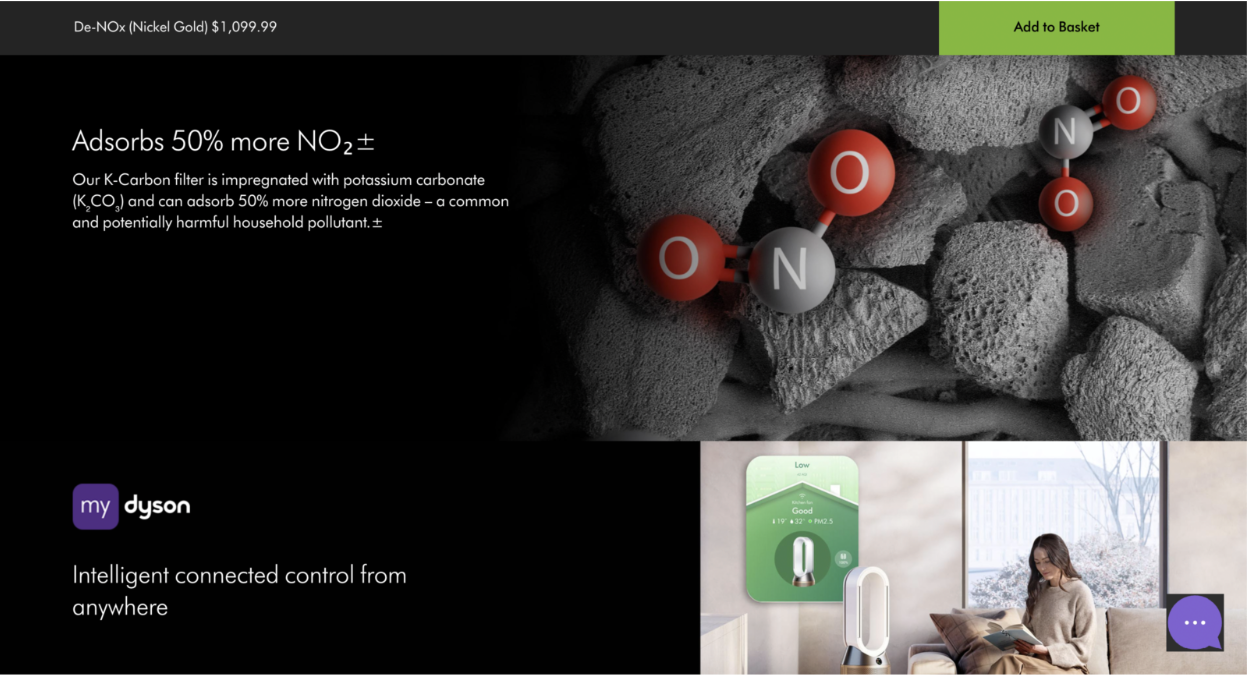
Caption: An example of scientific performance claim in Dyson product detail page.
In Vietnam context, Commerce = content = community. Consumers increasingly expect commerce platforms to:
- teach (reviews, videos, live demos)
- entertain (livestreams, creator content)
- assure (real-user tests, brand accreditation)
E-commerce platforms are evolving into brand ecosystems. Shopee. Mall and LazMall offer brand-owned stores with curated content, TikTok Shop PDP videos influence conversion during peak demand, while Livestream rooms replace mid-funnel education for many categories.
Why it matters
Commerce is no longer a KPI endpoint — it’s a brand experience touchpoint.
- Higher conversion compared to static category benchmarks
- Reduced reliance on discounting
- Faster decision cycles, even for premium products
- AI + Human Creativity Is the Modern Operating Model
AI is transforming marketing operations — but not replacing human creativity.
AI enhances distribution and scale. Programmatic platforms automate bidding, deduplicate audiences, and optimize reach. Social and commerce platforms use AI for behavioral targeting and predictive intent. AI tools generate text, images, video, voice, and 3D assets at machine speed.
This is crucial for highly personalized campaigns, multi-SKU retail media, and surreal or experiential ad formats (fake OOH, AR/VR). Yet human creativity remains the differentiator. AI cannot replace cultural insight, brand narrative, emotional resonance, and locally authentic creator storytelling. Top brands outperform by pairing AI optimization with human-led creative strategy.
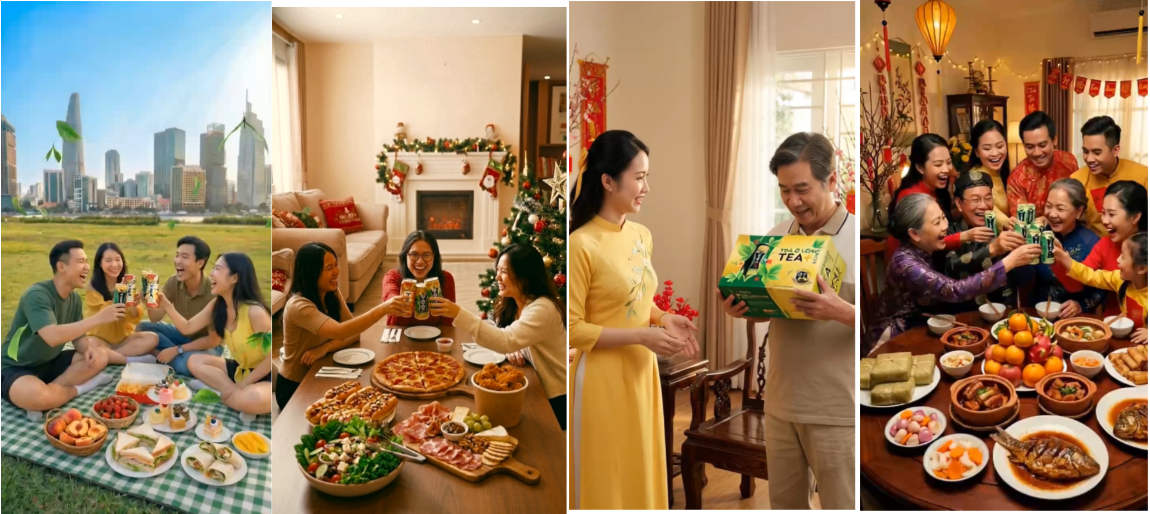
Caption: With AI, series of video ads can be created for different product use cases, dramatically reduce production time and cost.
Why it matters
- Better multi-stage funnel distribution
- Lower CPA
- Faster production cycles
- Lower creative cost
- More innovative formats
The future is hybrid: AI scales performance; humans create meaning.
In Summary: The Full-Funnel Model Has Shifted from Linear to Adaptive
Winning brands are building a new blueprint:
- Loops, not ladders — continuous discovery-to-purchase cycles
- One creative engine — unifying brand + performance
- Multiple micro-funnels — aligned to real-time intent signals
- Commerce as storytelling — not just a checkout step
- Hybrid operations — AI automation + human creativity
With one of the world’s highest social-commerce adoption rates and rapidly expanding retail media ecosystems, Vietnam is uniquely positioned to lead this next era of adaptive full-funnel marketing.
Source of information:
- https://en.vietstock.vn/2025/02/gross-value-of-vietnams-main-e-commerce-platforms-hit-126-billion-in-2024-38-599406.htm
- https://en.vietstock.vn/2025/02/vietnam-e-commerce-sales-to-hit-154-billion-in-2025-38-600062.htm
- https://english.vtv.vn/news/vietnamese-consumers-spend-16-billion-usd-on-online-shopping-in-2024-20250628084107438.htm
- https://datareportal.com/reports/digital-2024-vietnam
- https://newsroom.tiktok.com/tiktok-shop-is-where-shoppers-come-to-discover
- https://shoppable.innity.com/