Not long ago, AI entered marketing teams quietly. It took on the role of the eager intern: writing captions, summarizing meeting notes, and polishing headlines until they sounded slightly less awkward. It was classic intern behavior – helpful, task-oriented, and entirely dependent on human instruction.
But today, that intern is asking bigger questions. It is no longer just asking “How do I write this?” It is asking:
- Which creative should run next?
- Which audience is showing high intent right now?
- Should we shift budget from Search to Social before lunchtime?
We are hitting a tipping point many marketers feel but haven’t yet named. AI is moving beyond the “writing” phase and into the “deciding” phase.
From Productivity Tools to Agentic Workflows
Most teams are still stuck in the surface-level phase of AI, specifically using it for content ideation or light analysis. While this phase delivered speed and reduced friction, it did not fundamentally change how marketing operates.
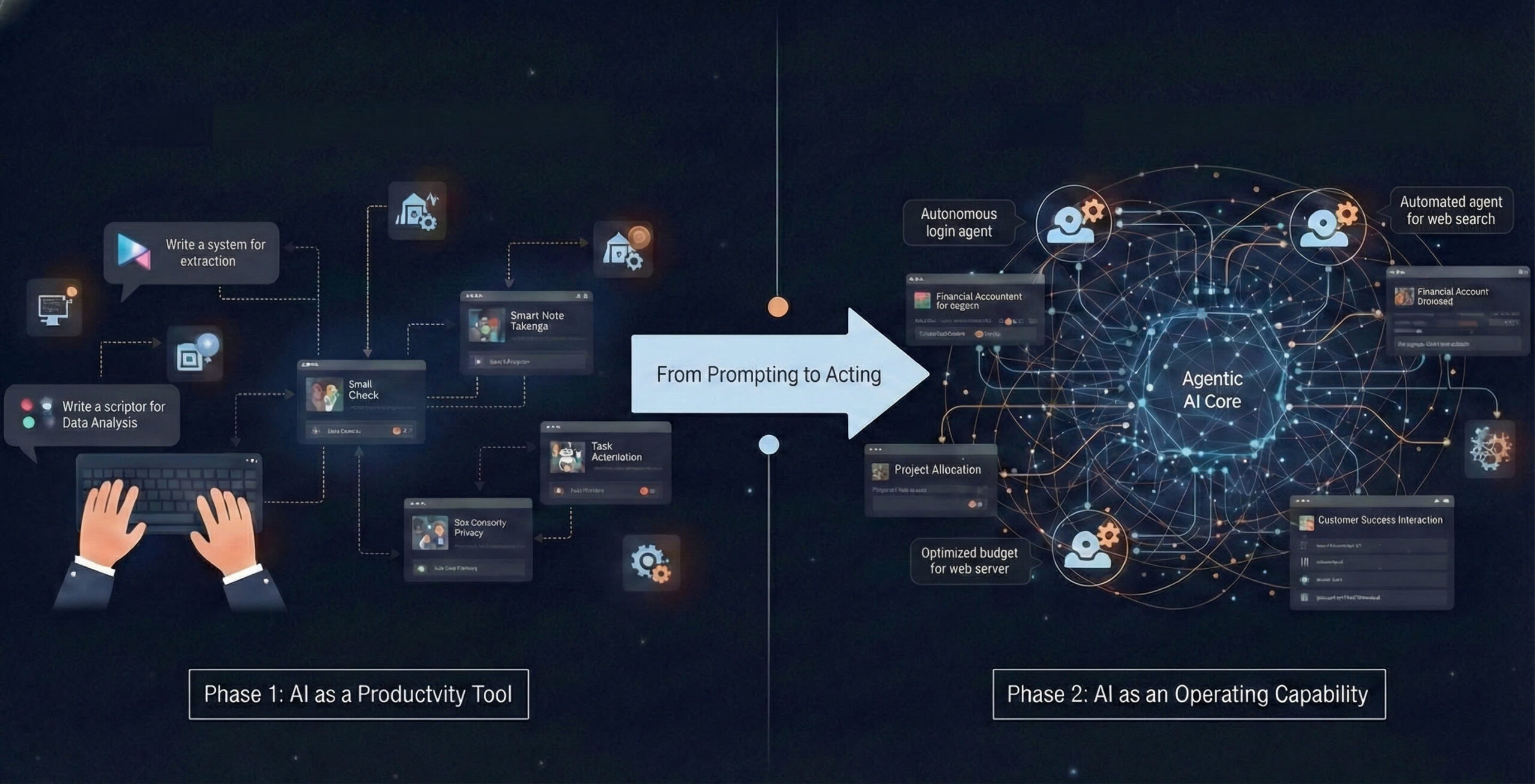
The next phase does. We are moving from simple automation to Agentic AI.
In an agentic workflow, AI stops waiting for a prompt at every turn. Instead of being a tool you “use,” it becomes an “agent” that acts within a defined scope. It doesn’t just draft an email; it monitors campaign performance, identifies a drop in engagement, and autonomously adjusts the send time or segmenting logic to hit a goal.
Campaigns no longer move in weekly cycles. Optimization happens while humans are still in meetings discussing last week’s numbers.
Why the Shift is Inevitable
This transition is being driven by two colliding forces. First, unmanageable complexity has made manual coordination nearly impossible. Managing dozens of channels, formats, and signals at scale has simply outgrown human speed.
Second, performance pressure has reached an all-time high. With budgets under the microscope, CFOs are demanding clearer impact. Wasted spend is no longer tolerated as the “cost of learning.” Agentic AI sits at this intersection, as it absorbs complexity and accelerates the learning curve without requiring a linear increase in headcount.
The Real Work is Finally Exposed
When AI starts making execution decisions, the natural fear is replacement. In practice, the opposite happens: human work becomes more visible.
As execution becomes automated, the value of strategy, judgment, and creative direction skyrockets. AI can optimize toward a goal, but it cannot decide if that goal is ethical or if it aligns with the brand’s ten-year vision. It can maximize a conversion rate, but it doesn’t know if that conversion is “toxic” for long-term brand equity.
The uncomfortable truth is that when AI takes over routine execution, a weak strategy has nowhere to hide.
The Risk Isn’t the Tech – It’s the Governance
The biggest barrier to this new era is not the technology; it is trust. To move toward agentic workflows, organizations must answer hard questions:
- Who defines the “guardrails” the AI operates within?
- Who owns the outcome when a system acts autonomously?
- How do we measure value beyond short-term clicks?
The organizations that win will not be the ones with the most tools. They will be the ones that treat AI as an operating capability rather than a creative gadget.
The New Mandate
Think back to the intern. At first, you give them small tasks. Then responsibility. Eventually, you grant them autonomy and judge them by outcomes, not effort.
AI is following that exact career path. Treat it like a “copywriting intern” forever and you will never see real ROI. Give it responsibility without a governance framework and you will regret it.
The question is no longer whether AI can do more. It is whether your marketing organization is ready to move from asking AI to help to trusting AI to act.
The intern has already grown up. It is time to update the job description.