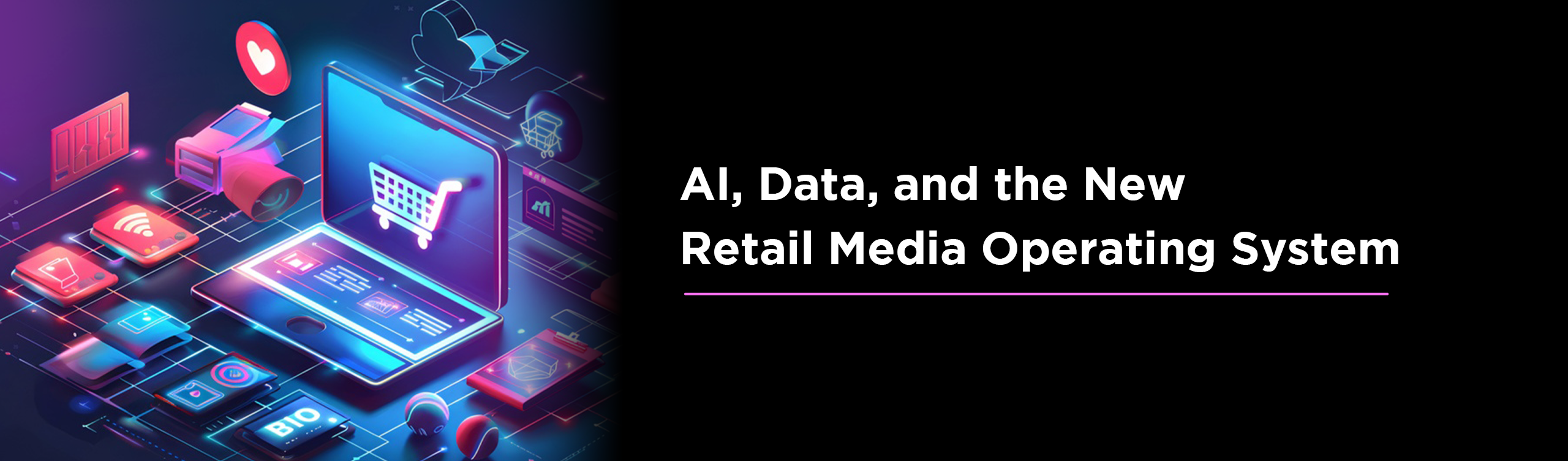
For more than a decade, retail media has been treated as an add-on: a handy performance lever tacked onto trade plans, lower-funnel budgets, and marketplace presence. That era is ending. AI is turning retail media from a tactical extension into the connective tissue for modern commerce, an operating system that links inventory, data, and measurement across platforms, partners, and teams.
In APAC especially, this shift is being catalysed by two converging realities. First, consumer journeys have fractured into a continuous loop of streaming, scrolling, searching, and shopping, often compressed into a single session, across multiple screens.
This piece explores how AI, data, and retail media are fusing into a single commerce operating system and what that means for marketing leaders in 2026.
From 4S Behaviours to Influence Maps
In the latest MMA RMNIL Podcast, Amita Mehra, Head of Agency Solutions, Southeast Asia at Google, describes today’s consumer journey as a constant loop of “streaming, scrolling, searching, and shopping”, best understood through dynamic influence maps rather than linear funnels. Consumers no longer follow linear paths to purchase. They oscillate between these four dominant behaviours, often jumping from video to social feeds, then into marketplaces and physical stores in rapid succession. In that environment, static funnel models break down. Mehra’s reference to 4S behaviours and BCG’s influence maps underlines a crucial point: marketers must design for a network of signals, not a staircase of stages.
Only AI can process these complex influence maps in real time and then automate media execution against them. Instead of manual rules and channel-based optimisations, AI ingests signals across video views, search queries, product page visits, and cart activity, then dynamically reallocates budget and creative to where it can shift propensity to buy. Planning around fixed funnel stages becomes less useful than planning around influence zones, where retail media serves as a live surface for AI-led intervention.
From Siloed RMNs to an AI-Fuelled Network
Historically, Retail Media Networks have been built as walled gardens: each retailer running its own campaigns, dashboards, and data policies, with brands and agencies stitching together reporting after the fact. That model is buckling under the weight of complexity and growth expectations.
The emerging alternative is a network-of-networks powered by shared AI and infrastructure. When a single platform can connect media buying with major marketplaces across APAC – from Shopee and Lazada to Rakuten and Flipkart – retail media stops being a series of isolated channels and starts behaving like a connected system. AI-powered campaign types and bidding models ingest signals across these environments, optimising for commerce outcomes rather than surface-level metrics.
Measurement sits at the heart of this evolution. As Amita Mehra notes, retail media’s true power is its ability to close the loop between exposure and on-site sales, and AI is what makes that loop both scalable and predictive. The ambition is to move beyond simple last-click metrics to genuinely attribute every dollar spent to tangible business outcomes: conversion value, lifetime value, average order value, new customer acquisition, and even store visits. Retailers still protect their first-party data, but APIs, cloud infrastructure, and clean-room technologies make it easier to connect that data with platform and brand signals in a privacy-safe way.
For APAC brands, this represents a structural shift: from managing dozens of retail media relationships individually to leveraging an AI-enabled fabric that scales across markets and partners.
AI as Infrastructure: What CMOs Need to Change
Treating AI as a campaign feature is easy. Treating it as infrastructure is harder and far more consequential. When AI becomes the operating system for retail media, three things must change for CMOs.
- Org design: breaking the trade–brand–media silos
Retail media sits at the intersection of trade, shopper, brand, and digital teams but most organisations still fund and measure these functions separately. AI-infused retail media exposes the cost of that fragmentation. To unlock its full value, leaders need joint planning across functions, anchored in shared business outcomes: revenue growth, incremental sales, new buyer acquisition, margin impact, and lifetime value. Annual planning with platforms and agencies should start from these unified metrics, not channel budgets. - Data strategy: moving from ad hoc sharing to deliberate collaboration
If retailer first-party data is the crown jewel, then collaboration is the new craft. Clean rooms, cloud environments, and integrated CDPs become essential infrastructure, allowing retailers, platforms, and brands to combine intent, loyalty, and media-exposure data without compromising privacy. The strategic questions for CMOs shift from “Can we get the data?” to “Which partnerships, architectures, and governance models will give us sustainable advantage?” - KPIs: redefining what ‘good’ looks like
Channel-level ROAS will not disappear, but it becomes only one tile in a larger mosaic. When AI orchestrates media across streaming, search, marketplaces, and in-store, success is better expressed in full-funnel, full-journey terms: contribution to brand equity and consideration, incremental revenue versus baseline, growth in high-value segments, and cross-channel path efficiency. This is where frameworks like Brand as Performance gain traction, connecting upper-funnel influence to lower-funnel commerce outcomes within a single measurement spine.
For instance, Amita Mehra points to L’Oréal working with WPP and Google to activate Demand Gen alongside YouTube Shopping affiliates. By turning organic affiliate content into a performance engine and letting AI optimise across formats and audiences, the team reportedly delivered roughly three times the expected performance.
This is more than an isolated success story. It demonstrates how AI, data, and retail media can work as an integrated system: creator content builds consideration, AI identifies high-intent audiences, retail and marketplace surfaces capture demand, and closed-loop measurement validates impact. The operating system is not a single tool; it is the orchestration layer that connects creative, media, and commerce around shared outcomes.
Retail Media as the Commerce OS for 2026
As AI, data, and retail media converge, a new reality is taking shape: retail media is no longer just a high-ROI line item; it is becoming the backbone of how commerce is planned, activated, and measured. The brands that win will be those that stop asking “Where do we plug AI into retail media?” and start asking “How do we rebuild our operating system so AI can orchestrate retail media and everything around it by design?” For CMOs, that is not a five-year vision. It is a 2026 imperative.