Three shifts that redefine where marketing value is created—and why speed alone isn’t enough
AI isn’t changing marketing because it can generate more content.
It’s changing marketing because it’s removing friction from how decisions are made.
Consumer signals now move continuously. Intent shifts. Performance updates. Creative resonates or fails. Commerce outcomes materialize—all in near real time.
Yet most marketing organizations still operate on episodic decision cycles: weekly reviews, monthly optimizations, quarterly reallocations.
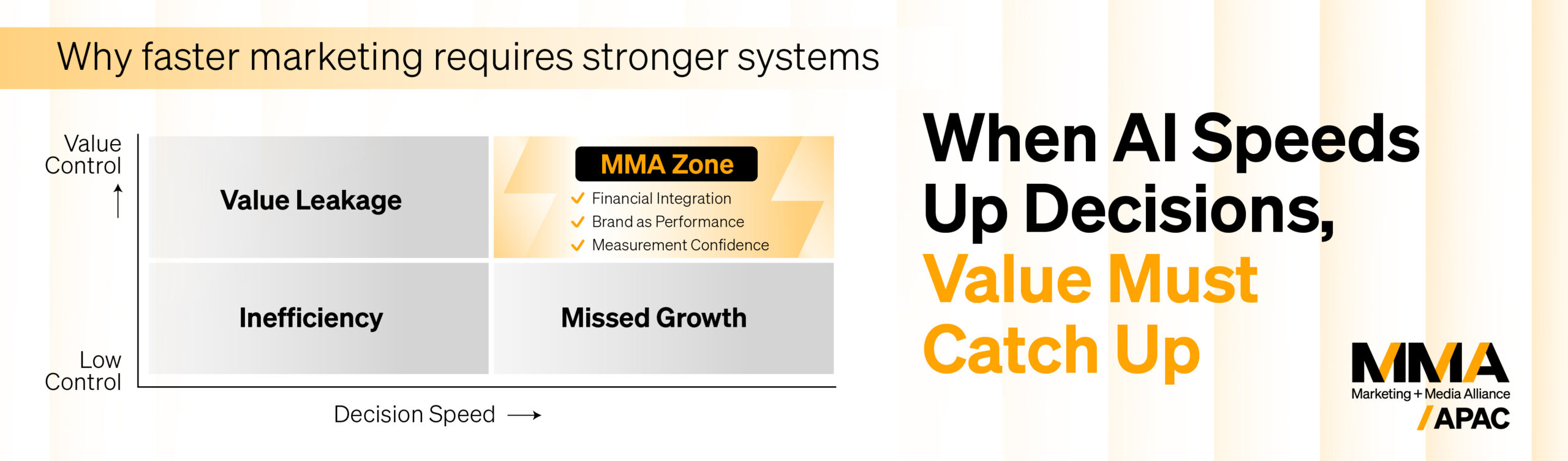
That gap between signal speed and decision speed is where value disappears.
What follows are three structural insights shaping marketing in 2026—and how forward-thinking organizations are converting them into enterprise value.
Insight 1: Faster Decisions Without Financial Integration Destroy Value
AI dramatically accelerates decision speed.
Budgets shift faster. Creative rotates faster. Targeting adjusts in real time.
But here’s the uncomfortable truth: speed alone is not advantage.
Without proper financial integration, AI simply optimizes toward what’s most visible—usually short-term performance metrics. The risk isn’t inefficiency. It’s misallocation of capital at scale.
This is why many organizations see activity increase without confidence that marketing is actually creating enterprise value.
The Solution: Connect Speed to Value
For the first time, marketing decisions can be connected through finance-grade formulas to both short-term financial impact and long-term firm value.
When AI removes execution friction, this shared system becomes essential. It ensures that automated optimization doesn’t erode the brand value that drives disproportionate long-term revenue.
Research shows that long-term sales impact can be approximately 7× greater than what’s visible during the campaign window. AI-powered speed without this understanding doesn’t just miss opportunity—it actively destroys value.
AI makes decisions faster. Financial integration defines what those decisions must protect.
Insight 2: AI Advantage Comes from Coordinated Systems, Not Isolated Tools
Most organizations already “use AI.”
They’ve adopted tools for content generation, media buying, personalization, analytics.
But few have redesigned how decisions connect across planning, creative, media, and measurement.
This is the real source of friction.
When AI is applied in silos, optimization remains local and learning decays. When AI coordinates decisions across the marketing lifecycle, learning compounds.
Growth doesn’t improve because tasks are automated. Growth improves because decisions stop waiting for coordination.
The Solution: Scale Proven Logic, Don’t Reinvent It
The best marketing organizations aren’t starting from scratch with AI. They’re using AI to scale frameworks that already work.
Take proven growth planning logic that delivers +50% to +100% ROAS lift through the right balance of reach, precision, and sequencing. AI doesn’t invent this logic—it scales it.
But scaling requires more than tools. It requires:
- Governance that defines what AI can optimize for—and what it must protect
- Workflow design that embeds AI into decision flows, not alongside them
- Capability fit that ensures teams can operate AI as a system, not run pilots indefinitely
AI becomes an institutional capability only when decisions are designed to connect end to end.
Insight 3: Removing Friction Exposes Organizational Weakness
Here’s what nobody tells you about AI-powered marketing:
As execution friction disappears, strategy quality becomes visible very quickly.
Unclear objectives? AI will optimize in conflicting directions. Misaligned KPIs? AI will create local wins that undermine system value. Weak measurement? AI will learn from noise instead of signal.
These issues were always present. Friction just hid them.
AI doesn’t create instability. It reveals it.
Organizations with strong strategic clarity experience leverage. Organizations without it experience volatility.
The Solution: Build Confidence Into the Foundation
Decision-grade confidence doesn’t come from dashboards. It comes from:
- Incrementality measurement that isolates true marketing contribution
- Attribution maturity that connects touchpoints to outcomes reliably
- Predictive linkage to business results that CFOs actually care about
At the same time, high-performing organizations recognize that structure isn’t the answer. Fit is.
Performance correlates most strongly with alignment between strategy, capabilities, and measurement logic—not headcount, not org charts, not tools.
When AI accelerates decisions, this alignment becomes non-negotiable. Measurement and organizational design move from hygiene factors to growth drivers.
What This Means for Marketing Leaders
AI is removing friction whether your organization is ready or not.
The competitive advantage in 2026 won’t belong to those with the fastest tools.
It will belong to those with:
- Financial systems that connect speed tovalueSo AI-driven decisions optimize for enterprise outcomes, not just campaign metrics.
- Growth logic that AI can scale responsiblySo automation amplifies what works instead of acceleratingwhat’s broken.
- Organizations designed to learn without driftingSo continuous optimization stays aligned with long-term brand and business strategy.
The Bottom Line
AI accelerates decisions.
Leadership ensures those decisions create value.
That’s the difference between automation and transformation.
The question isn’t whether AI will change how marketing works—it already is.
The question is whether your organization is designed to capture that value, or whether speed will simply expose the gaps you’ve been too busy to fix.
Want to go deeper? Explore frameworks for financial integration, AI transformation, and growth strategy designed for the today marketing leader at https://www.mmaglobal.com/apac/join-our-global-programs?utm_source=mma&utm_medium=marketingtnt&utm_campaign=apac